June 6, 2025
Paul Laursen
Why this guide exists Rowers keep asking one big question: “What’s the smartest way to train so I can pull faster splits — without burning out?” Most Googled answers are static PDF schedules or one‑size‑fits‑all app workouts. Good for a week, useless once life, fatigue, or regatta dates change. Athletica fixes that problem with an […]

Rowers keep asking one big question:
“What’s the smartest way to train so I can pull faster splits — without burning out?”
Most Googled answers are static PDF schedules or one‑size‑fits‑all app workouts. Good for a week, useless once life, fatigue, or regatta dates change.
Athletica fixes that problem with an adaptive engine proven in triathlon, cycling, running and HYROX. This guide shows how it works for a rowing training plan, who it helps, and how to start a 14‑day free trial in five minutes.
You are…Your goalSkip toSelf‑coached indoor rowerSmash a PR on the Concept2 2 k, 5 k or 60‑minAdaptive engineMasters athlete (40+)Stay fast & healthy through busy weeksMasters focusHybrid / HYROX / CrossFit competitorDrop split times for race segmentsHybrid athletesCoachManage squads with science‑backed individualized plansCoach dashboard
And why adaptive beats “print‑and‑pin” every time
Bottom line: you’re running blind; progress stalls, motivation drops and injury risk climbs.
Studies show that combining high‑intensity intervals with aerobic base work:
Athletica’s rowing training plan embeds these findings automatically. You get the evidence-backed dose‑response without necessarily having to read journals.
Earlier this year Athletica teamed up with USRowing and the Science of Rowing education series to deliver a 70‑minute masterclass on how modern physiology, high‑intensity interval research and AI‑driven analytics are reshaping rowing preparation. The first half, led by PhD candidate Joseph DeLeo, dissects the building blocks of 2 k speed; the second half sees Dr Paul Laursen translate those findings into Athletica’s adaptive engine. If you’d rather watch than read, hit play below. The key timestamps and a searchable transcript sit right under the video for easy reference.
[00:05] Joe DeLeo:“This will be a two‑part presentation. I’ll set the physiological scene, then hand the baton to Dr Paul Laursen.
00:27] Joe — background: Third‑year PhD candidate (University of Kansas), former strength & conditioning coach for Portuguese Rowing Federation, now supporting USRowing para program.
[01:10] Speaker intros: Paul Laursen — ex‑High Performance Sport NZ physiology lead (2009‑2016), co‑author HIIT Science, co‑founder of Athletica.ai.
[02:04] Athletica snapshot: Platform uses AI to individualise endurance plans across running, cycling, triathlon & rowing; adapts as athletes upload new data.
“Training at 24 spm doesn’t magically convert to 38 spm race cadence.”
[10:30] What is HIIT? Repeated bouts in the red‑zone (≥VT2) with recovery; lets athletes accumulate more high‑intensity volume than continuous work.
[17:54] Intensity‑control (“Norwegian method”): Precision pacing + lactate caps ensure sustainable adaptation.
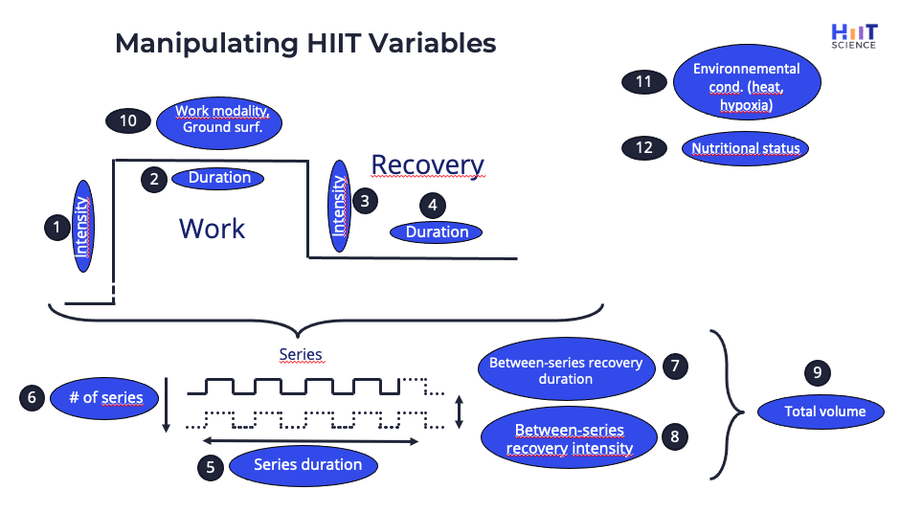
[22:10] Lever diagram: Key manipulators — work‑bout intensity/duration, recovery intensity/duration, total reps, modality, nutrition, environment.
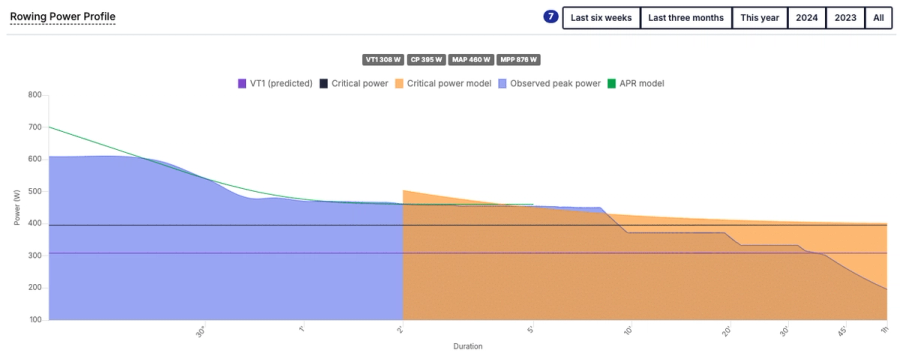
Upload your rowing training history (sync your Garmin/Concept2 ErgData) and the platform calculates functional threshold power/pace and heart‑rate zones — no lab visit needed.
Your curve updates after every row, letting the AI fine‑tune interval targets for 250 m sprints, 2 k race pace, or 30‑min pieces.
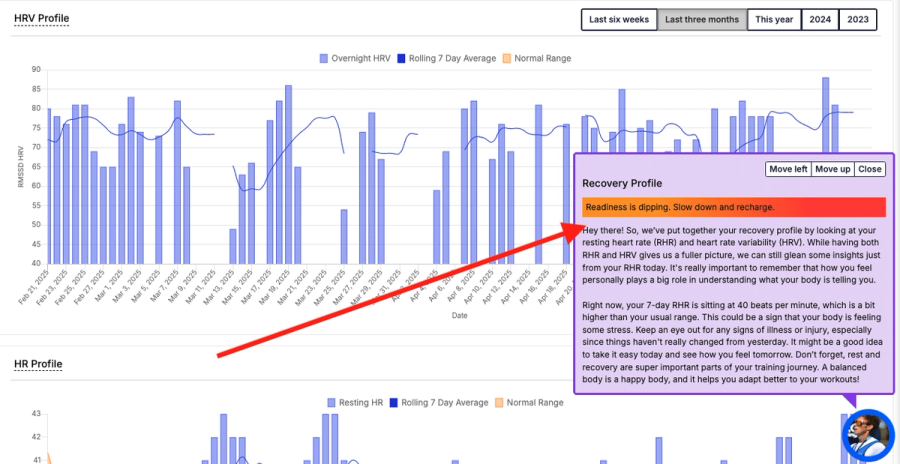
Morning HR, HRV, sleep hours and RPE feed into the platform’s readiness assessment. A chat‑style AI-Coach then explains your recovery status as shown.
Peer-reviewed longitudinal data show that VO₂ max declines ≈12 % per decade in sedentary men, but just 5–6 % per decade in endurance-trained masters athletes who continue to train (Rogers et al., 1990, J Appl Physiol). These findings underscore the value of consistent aerobic work and manageable intensity for healthy aging.
Athletica’s adaptive plans are suitable for Masters rowers, as they determine individual readiness for training no matter who you are.
Result: sustainable power progression, fewer niggles, and consistent training enjoyment.
A fast split is meaningless if every stroke leaks watts. Two mechanical levers drive boat speed:
Elite crews optimise the product of the two, not just one or the other. Most club rowers, however, spend >80 % of training below 26 spm and then “shock” the system at 36 spm on race day. The result: blown legs and sloppy catches.
Intensity bandTypical spmTarget split cueUT2 steady18–22“Should feel conversational”UT1 / aerobic power22–26–6 to –12 s vs 2 k splitThreshold26–30–4 to –6 s vs 2 k splitRace‑specific32–38Goal 2 k split or faster
Dialling in the right training zone in line with your stroke rate during every phase of training means your race‑day jump to 34–38 spm feels rehearsed, not risky.

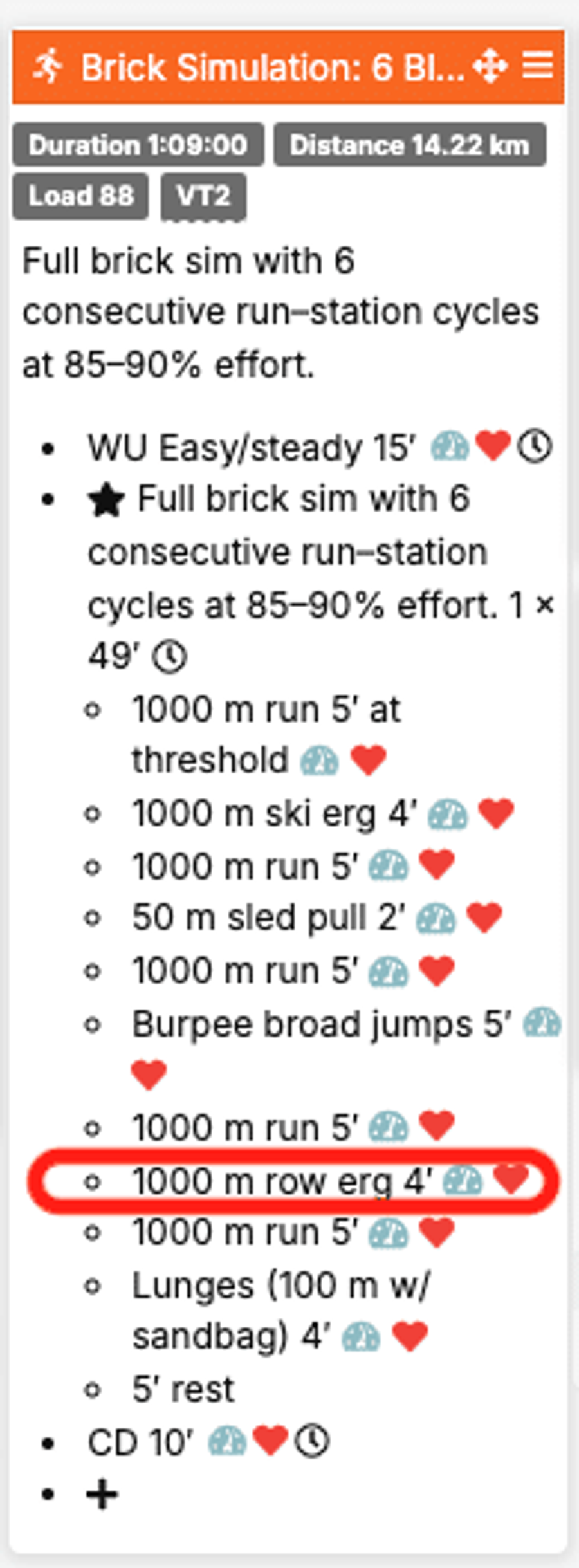
HYROX and CrossFit demand a 1 000 m or 500 m blast inside multi‑modal events. The adaptive plan slots rowing HIIT around running, sled pushes and strength so you hit race day fresh.
Example HYROX workout:
No more spreadsheet chaos.
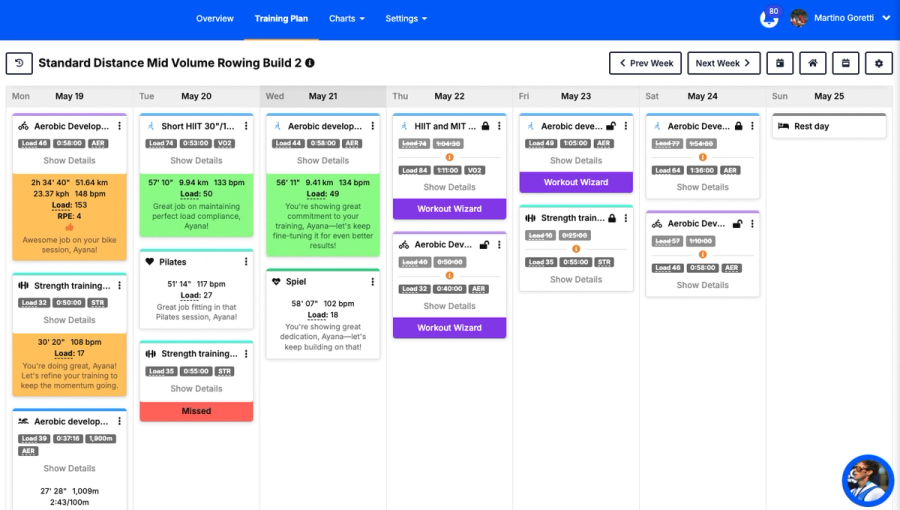
With Athletica’s rowing training plans, Martino finds the right balance between structure and flexibility:
The adaptive platform has made his job easier by centralizing performance data, monitoring HRV, and offering session tweaks based on recovery. It’s not just a tool for elite athletes — Martino views Athletica as a coach’s assistant, a resource for learning and a way to deliver high-quality training to more people.
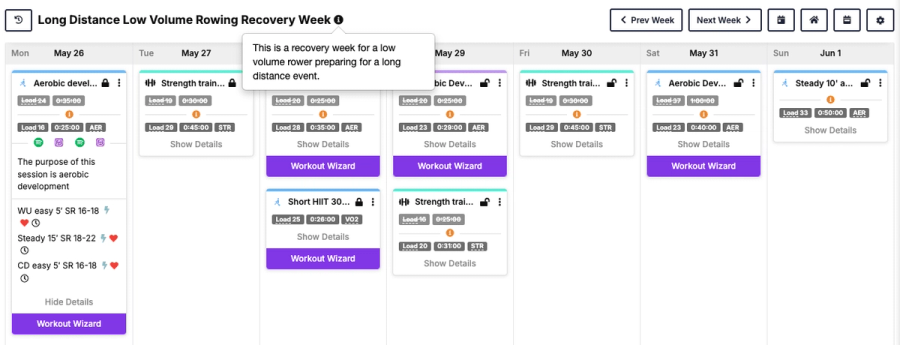
Just one example of a recovery training week for a low volume rower is below. Choose from hundreds of different options within Athletica based on your individual training needs.
Start Free Trial
Click Start My Adaptive Rowing Plan and see the difference in your very next session.



