Real-World Heat Acclimation: Practical Strategies and Female Athlete Considerations
July 8, 2026
Julia Casadio, PhD.
Sport physiologist Dr. Julia Casadio breaks down practical heat acclimation strategies — including what female and teen athletes need to do differently to adapt.
One of the biggest challenges we faced preparing athletes for the Tokyo Olympic Games wasn't convincing them that heat acclimation worked, it was finding enough time to do it.
Like most coaches, we were trying to balance training loads, competition schedules, travel and recovery, while still preparing athletes to perform in the heat. The challenge wasn't the science, it was making the science practical. That was exactly what my PhD set out to explore.
When I started my PhD around 13 years ago with the New Zealand Olympic programme, we already knew that repeated exercise in the heat improved thermoregulation, reduced cardiovascular strain and enhanced performance in hot environments. We also knew heat could be used as an additional training stimulus, to elicit performance benefits in temperate conditions. The questions coming from coaches were much more practical:
How do we fit heat acclimation into an already busy training programme?
How can we make it sport specific?
Can we use heat as another training tool?
How do we maximise the benefits without compromising the rest of training?
Those questions shaped my research and they still shape how I think about heat training today. Whether you're preparing for a marathon, Ironman, HYROX event or simply trying to perform better through summer, I think the biggest lessons are surprisingly simple:
Make heat training practical.
Individualise it.
And remember that some heat exposure is almost always better than none.
Best practice vs. real life
Before we talk about practical strategies, it's worth understanding what actually drives heat adaptation. To gain the thermoregulatory adaptations we're looking for, your body needs two key stimuli:
A meaningful increase in core body temperature (≥ ~38.5°C).
Enough heat stress to sweat profusely.
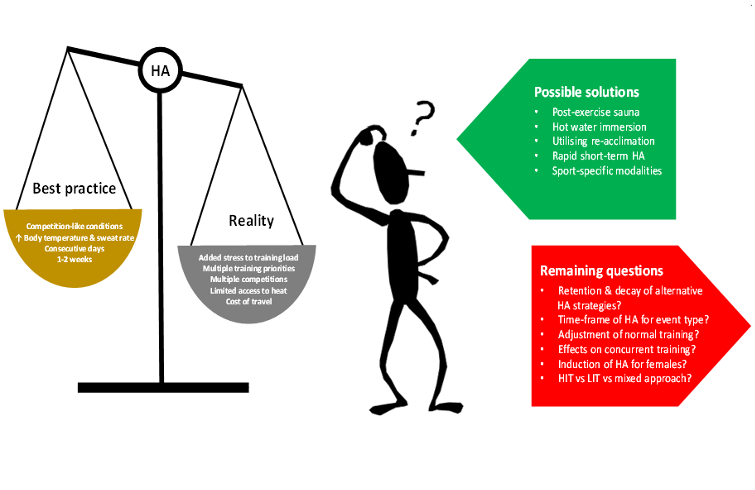
Repeated over consecutive days, these signals trigger the adaptations that make exercising in the heat feel easier and improve performance. The gold standard remains around 7–14 consecutive days of heat exposure. But let's be honest, most athletes don't have two uninterrupted weeks available. Between work, family, travel and everything else that goes into training, following the textbook protocol isn't always possible.
Fortunately, it doesn't have to be all or nothing. Research now supports practical options such as post-exercise sauna bathing and hot water immersion when training in the heat isn't feasible. They may not completely replace sport-specific heat training, but they can provide an effective heat stimulus while fitting much more easily into everyday life.
The other point that's often overlooked is that heat is another training stress. Don't simply layer it on top of an already demanding training block. Instead, try introducing heat during an easy-to-moderate training week, and remember that what looked like an "easy week" on paper may become a hard week once heat is added. Recovery, hydration, nutrition and sleep all become even more important.
And one final tip, if you're already run down or fighting an illness, don't start a heat block. Heat is an additional physiological stress and can further challenge an already compromised immune system.
Fig 2. Integrating best practice heat acclimation (HA) recommendations within the constraints and complexities of an elite athlete’s training and competition schedule. HIT = High-intensity training, LIT= low-intensity training, ↑ = increased. Used with permission from Casadio et al., 2017.
The athlete matters more than the protocol
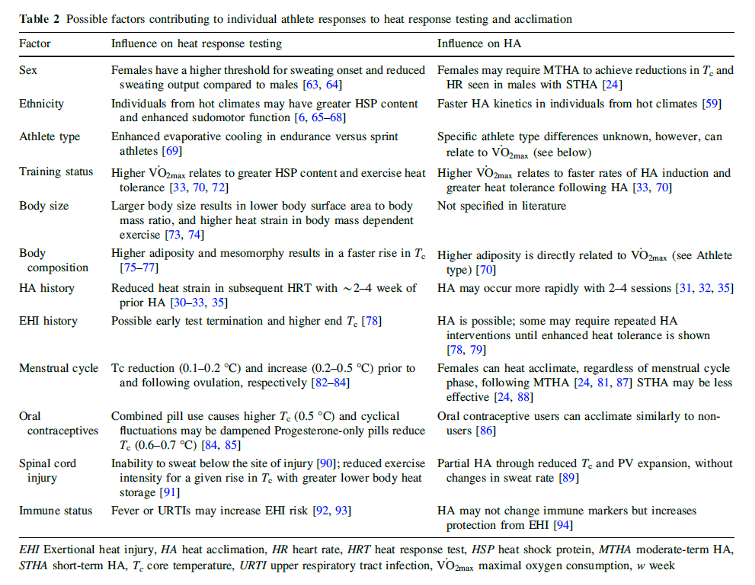
One of the biggest mistakes I see is assuming everyone adapts to heat in the same way. They don't. Your response to heat is influenced by a range of individual factors including:
Sex
Training status
Body size and body composition
Previous heat exposure
Previous exertional heat illness
Menstrual cycle
Hormonal contraception
Ethnicity
Immune status
That's why I encourage athletes to practise a heat acclimation block well before an important event. If you have access to a sport physiology laboratory, a formal heat response test can be extremely useful in understanding your individual response to the heat and then again following a heat acclimation block to see how effective it was. In saying that, you don't need expensive equipment to learn how your body responds.
If you're using sauna after training, for instance, try recording a few simple measures:
Heart rate
Body weight before and after (to estimate sweat loss)
Thermal comfort (‘How comfortable am I with the temperature of my body’)
Thermal sensation (‘Hot hot or cool does by body feel’)
Over time, you should notice lower heart rates, improved comfort in the heat and often an increase in sweat rate, all signs that your body is adapting. Rather than asking, "Did I complete the protocol?", a better question is: "Am I adapting?"
Table taken from Casadio et al., (2017).
Females adapt differently than males
This is probably where I've seen the biggest opportunity for improving how we prescribe heat training. Historically, most heat acclimation research has been conducted in men, and many of the recommendations we still use today are based on predominantly male participants.
The good news is that women absolutely benefit from heat acclimation. The important difference is that they may require a different approach. Current evidence suggests many female athletes may benefit from a longer heat acclimation block, often closer to 10–14 days, whereas meaningful adaptations can occur in many men within 4–7 days.
One possible explanation relates to sudomotor function, or how the body produces sweat. Compared with men, women generally begin sweating at a higher core temperature and produce less sweat for a given heat load. Because repeatedly elevating body temperature and stimulating sweating are two of the major drivers of heat adaptation, it may simply take women longer to accumulate the same physiological "heat dose."
That doesn't mean women are poor responders. It simply means they may need a different dose.
When time doesn't allow, get creative
Of course, in elite sport, we don't always have 10–14 days. Preparing athletes for the heat during the Tokyo Olympic cycle highlighted this perfectly. With some of our female athletes, we experimented with adding around 15 minutes of sauna exposure immediately before heat chamber cycling sessions.
The rationale was straightforward. If athletes started the session already warm, they could potentially spend longer at the physiological stimulus required to drive heat adaptation. In practice, we observed encouraging reductions in exercising body temperature and cardiovascular strain (heart rate) after around five to seven days.
This wasn't a controlled research study, so I certainly wouldn't claim that pre-heating accelerates heat acclimation. But I think it demonstrates an important coaching principle. Rather than asking, "What's the perfect protocol?", we asked, "What's the best solution given what we have to work with?"
What about teenage athletes?
Over the past few years, my focus has expanded beyond elite sport through Her Strength, an education platform I founded to help coaches, parents and sporting organisations better support adolescent female athletes through puberty and adolescence. One question that comes up is whether young athletes should also be heat acclimating. The answer is yes, but with an even greater emphasis on education and safety.
Healthy adolescents can adapt to the heat, but they need to understand the basics: arriving well hydrated, fuelling appropriately (particularly with carbohydrates during longer sessions in the heat), recognising the early signs of heat illness, and knowing when to slow down or stop training.
When it comes to adolescent girls, however, the evidence becomes much thinner. Puberty brings major changes in hormones, body composition and thermoregulation, yet we know very little about how these changes influence heat adaptation. Add in common factors such as menstrual dysfunction, low energy availability and Relative Energy Deficiency in Sport (RED-S), and there are still many unanswered questions.
Until we have better evidence, the same principle applies here as it does throughout this article: individualise the approach while prioritising both health and safety in the heat.
Practical takeaways
To stimulate heat adaptations, you need to elevate core body temperature and sweat profusely.
Aim for 7–14 consecutive days where possible. Many men may achieve meaningful adaptations within 4–7 days, while many women may benefit from 10–14 days.
Don't let perfect stop you. Sauna and hot water immersion are practical options when exercising in the heat isn't possible.
Treat heat as another training load. Plan it into your programme and increase your focus on recovery, nutrition, hydration and sleep.
Individualise your approach. Monitor and learn how you respond and adjust as needed.
Some heat exposure is almost always better than none.
Teen athletes can adapt too, but education and safety should always come first.
References:
Casadio, J. R., Kilding, A. E., Cotter, J. D., & Laursen, P. B. (2017). From lab to real world: Heat acclimation considerations for elite athletes. Sports Medicine, 47(8), 1467–1476. https://doi.org/10.1007/s40279-016-0668-9