Build a smarter HYROX training week with Athletica. Combine Zone 2 endurance, VO₂max intervals, functional strength, and recovery to perform better and age stronger.
Introduction: When Race Day and 100th‑Birthday Prep Collide
Hyrox has exploded from 650 athletes in 2017 to a projected 425,000 competitors across five continents in the 2024‑25 season, with participation up 118 % year‑over‑year. At the same time, Peter Attia’s Outlive made “Zone‑2 cardio” and “centenarian decathlon” household phrases, sending Google searches for longevity workouts soaring.
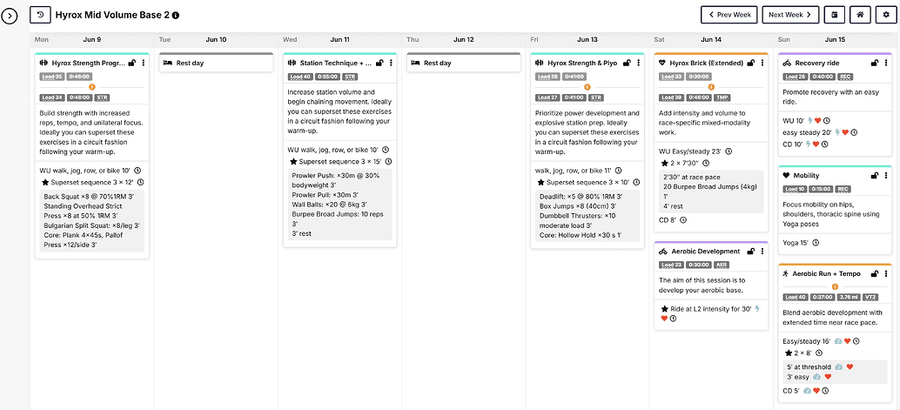
Athletica sits at the intersection. Our Hyrox training plans already combine low‑intensity endurance, high‑intensity power, and functional strength—exactly the ingredients that prolong both race performance and health‑span. This post shows you how to use Athletica’s Daily Availability feature to generate a training week that could carry you from the Hyrox finish‑line all the way to your 100th birthday.
Why Hyrox Is Basically a Longevity Lab
Hyrox RequirementLongevity BenefitPractical ExampleRepeated 1 km runs at steady powerBuilds mitochondrial density via Zone‑2 & Zone‑3/4 work4×1 km at race pace between stationsHeavy sled push & pullPreserves lean mass and bone density4× sled push at 70–80 % of 1 rep maximum (1RM)Farmer carry & lungesImproves grip strength—a mortality predictor2×40 m carries @ 50 % BWBurpee broad jumpsMaintains explosive power for fall‑prevention3×10 reps with 2 min rest
In other words, nail your Hyrox prep and you accidentally tick most boxes of a science‑based longevity routine.
Prescription: 4×4 min or 6×1 min above 90 % HRmax.Why: Raises VO₂max, a strong predictor of both Hyrox performance and lifespan.Listen:Athlete Compass Episode 63 — VO2Max Gains
Selecting a HYROX race goal in Athletica's plan setup
Athletica shortcut: Enter your available training windows inside Daily Availability. Our engine will auto‑adapt volume and intensity to your fitness level, exercise mode preference and recovery status.
Want to see how Athletica can help you perform your best at your
HYROX event?
How to Build Your Individualized Plan Inside Athletica
Register and open Settings → Training → About You → Hyrox.
Declare your endurance modalities in Daily Availability (run, cycle, row, swim).
Choose strength days you prefer (e.g., Tue & Thu).
Add race date (or “train-to-maintain” for pure longevity).
Watch your calendar auto‑populate.
FAQs
Is Zone‑2 the same for everyone?
No. A good way to estimate this is the maximal aerobic function (MAF) method. Calculate this using 180 minus your age. Athletica estimates this for you using its MAF test.
No. Not when kept to 2–3 compound sessions under 45 min alongside your endurance training. Strength is the scaffolding that lets you handle higher aerobic loads later.
Can I do this with zero gym equipment?
Yes. Swap sled pushes for heavy farmer carries or backpack lunges with any home-based items; wall balls can be done with a sandbag or other. Get creative!
What if I don’t care about racing—just living longer?
Simply choose ‘Train-to-maintain’ in your setting ‘goals’. This keeps you accountable to your training. Keep the simulation day but detach it from competitive pacing; think of it as a functional fitness check‑up.
How long should I train for a Hyrox race?
Most athletes need 8–12 weeks of structured prep if they already run and lift regularly. Beginners—or anyone chasing an elite finish time—should allow 16–20 weeks to build a robust aerobic base and master the stations. The good thing about the Athletica plans is that time to race is irrelevant – your plan is built out for you for any number of days to run.
Is Hyrox easier than CrossFit?
Skill‑wise, yes: Hyrox uses straightforward movements (sleds, rowing, lunges) and no Olympic lifts or gymnastics. Endurance‑wise it can feel tougher because over half the race is hard running. Think “easier to learn, hard to finish fast.”
How often should I do Zone‑2 training each week?
Aim for 2–4 Zone‑2 sessions of 45–90 minutes. That hits the mitochondrial stimulus without crowding out your high‑intensity or strength work. Time‑crunched athletes can start with two 30‑minute blocks and progress. Choose your time available using the Daily Availability feature in Athletica.
Is Zone‑2 cardio good for fat loss?
Yes. Training at this intensity preferentially increases your fat burning and recovery ability.
How heavy is the Hyrox sled, and how can I replicate it?
In the Open division the sled push is 152 kg / 335 lb for men and 102 kg / 225 lb for women (weight includes the sled). If your gym sled glides too easily, add 10–20 % extra plates or push on rubber flooring to match race friction.
Can I train for Hyrox and a marathon simultaneously?
Yes—treat Hyrox strength + station work as your mid‑week “quality” sessions and keep one long run at conversational pace. Many hybrid athletes follow a 4‑run + 2‑lift weekly pattern and see PRs in both events.
What VO₂max is linked to longevity, and how can I improve it?
Cardiorespiratory fitness is one of the strongest predictors of all‑cause mortality. A 2018 JAMA study of 122,000 patients showed that moving from “below average” to “elite” VO₂ max reduced death risk by up to 80 %. Aim for > 50 ml·kg⁻¹·min⁻¹ (men) or > 45 ml·kg⁻¹·min⁻¹ (women) before age 50, then expect ~1 ml/kg/min decline per decade. To boost VO₂ max:
- Keep 2–4 Zone‑2 sessions for a mitochondrial base
- Add 1–2 HIIT workouts (e.g., short or long intervals)
- Strength‑train large muscle groups to raise fast twitch muscle recruitment
Celis‑Morales CA, Welsh P, Lyall DM, et al. Associations of grip strength with cardiovascular, respiratory, and cancer outcomes and all‑cause mortality: prospective cohort study of half a million UK Biobank participants. BMJ. 2018;361:k1651.
Hood DA, Memme JM, Oliveira AN, Triolo M. Maintenance of skeletal muscle mitochondria in health, exercise, and aging. Annu Rev Physiol. 2019;81:19‑41.
Kodama S, Saito K, Tanaka S, et al. Cardiorespiratory fitness as a quantitative predictor of all‑cause mortality and cardiovascular events in healthy men and women: a meta‑analysis. JAMA. 2009;301(19):2024‑2035.
Laursen PB, Buchheit M. Science and Application of High‑Intensity Interval Training: Solutions to the Programming Puzzle. Champaign, IL: Human Kinetics; 2019.
Seals DR, Justice JN, Larocca TJ. Physiological geroscience: targeting function to increase healthspan and achieve optimal longevity. J Physiol. 2016;594(8):2001‑2024.
Srikanthan P, Karlamangla AS. Muscle mass index as a predictor of longevity in older adults. Am J Med. 2014;127(6):547‑553.
Weston KS, Wisloff U, Coombes JS. High‑intensity interval training in patients with lifestyle‑induced cardiometabolic disease: a systematic review and meta‑analysis. Br J Sports Med. 2014;48(16):1227‑1234.
Legal & Trademark Notice
HYROX® is a registered trademark of Upsolut Sports GmbH. Athletica Inc. is not endorsed by or affiliated with HYROX. Race names are used solely for descriptive and comparative purposes.