Pace vs Power vs Heart-Rate: How to Pick the Right Training Metric (and When to Switch)
June 13, 2025
Paul Laursen
Pace vs Power vs Heart-Rate: TL;DR (Skip-ahead) If your session is… Best primary metric Why Recovery / Zone 2 durability Heart-rate Captures internal load; auto-adjusts for heat, hills, fatigue. Long climbs or strength-endurance Heart-rate Target mid-zone power but reduce effort if HR drifts Tempo / Threshold (≥20 min) Pace (run) or Power (bike) Targets race-specific […]
Pace vs Power vs Heart-Rate: TL;DR (Skip-ahead)
If your session is…Best primary metricWhyRecovery / Zone 2 durabilityHeart-rateCaptures internal load; auto-adjusts for heat, hills, fatigue. Long climbs or strength-enduranceHeart-rateTarget mid-zone power but reduce effort if HR driftsTempo / Threshold (≥20 min)Pace (run) or Power (bike)Targets race-specific speed while HR plays “referee” in the background.VO₂/Interval work (30 s – 8 min)Pace / PowerExternal load responds instantly; HR lags.All-out sprints (≤30 s)PowerOnly power meters react fast enough.Hot, humid, or high-altitude daysHeart-rate overlayHR drift signals rising internal stress even if pace/power stay flat.
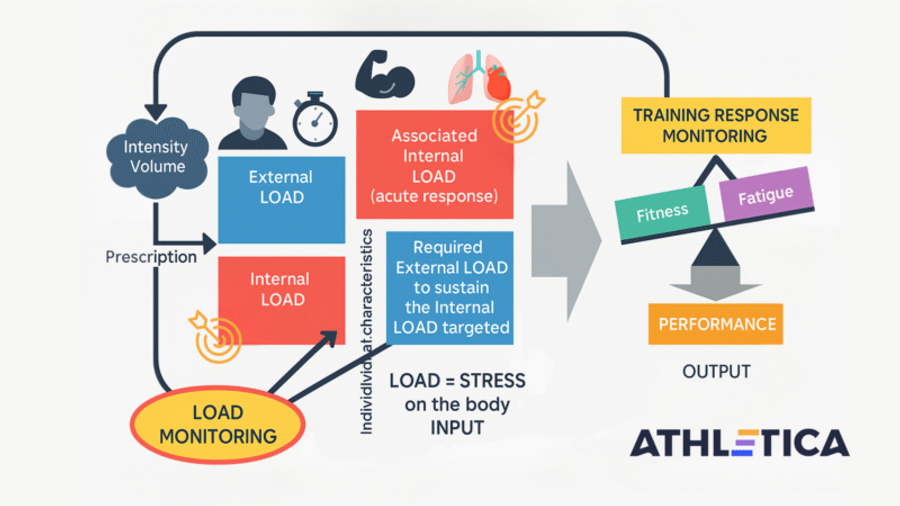
1. Why Metrics Matter: Internal vs External Load
Heart-rate (HR) is internal load – a window into how hard your cardiovascular system is working.
Pace (running speed) and Power (force × cadence) are external loads – what you’re outputting, independent of physiology.
Training gets messy when athletes treat these numbers as interchangeable. Understand the strengths and blind spots of each and you’ll prescribe effort that matches the goal of the day.
The science behind how to think about pace vs power vs heart-rate
2. Heart-Rate: The Internal Compass
Strengths
Direct measure of physiological stress and hydration status.
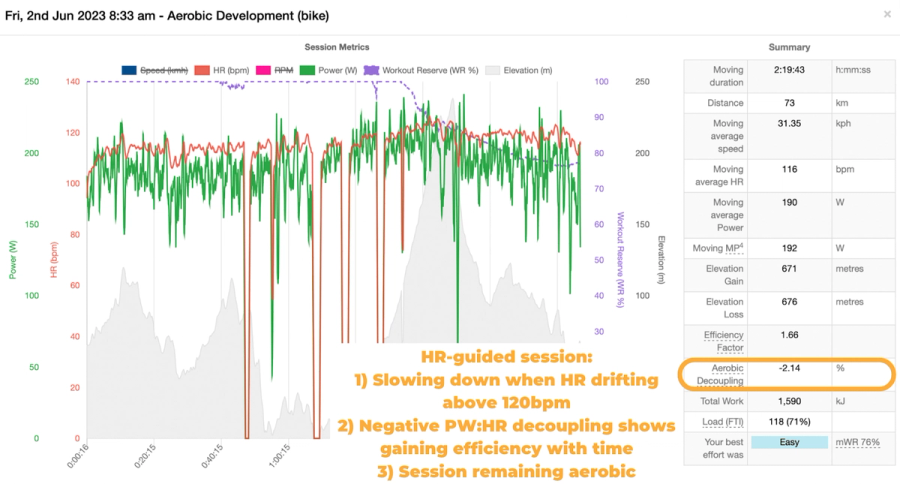
Automatically adjusts for temperature, altitude, and accumulated fatigue (cardiac drift).
Ideal for sub-threshold durability runs/rides/rows where the target is staying aerobic (Zone 2 / MAF).
Limitations
15–60 s lag when pace or power jumps.
Influenced by caffeine, stress, sleep, and illness.
Has a cap or ceiling at its maximal rate (top of Zone 5) and can’t go any higher than its max, even though pace or power can (e.g., sprints).
Use it for
Long Zone 2 runs, rides or rows.
Heat or altitude acclimation sessions where HR drift is the safety governor.
Single leg deadlift for HYROX strength training
3. Pace: Simple, Cheap, Surprisingly Powerful
GPS pace is still king for runners because it:
Responds immediately on flat terrain, letting you nail target speeds over 400 m repeats to ~20 min threshold blocks.
Pairs easily with race plans (“I need 4:30 min/km to break 1 h 35 for my half”).
Requires no gadgets beyond your watch/phone.
Watch-outs
GPS wobble in heavy tree cover or urban canyons.
Steep climbs or headwinds slow pace even though effort stays high (where HR or power shines).
Doesn’t scale perfectly across sports (i.e., doubly impacted by water current and wind for on-water rowing sessions).
Single leg deadlift for HYROX strength training
4. Power: The Objective Work-Rate
Cyclists discovered decades ago that a watt is a watt, whether on a calm road or a 9 % grade. Runners now have foot-pods (e.g., Stryd) that estimate horizontal and vertical forces to the tune of ±5 %.
Pros
Instant feedback – no physiological lag.
Terrain-agnostic pacing (normalises for hills & wind).
*Support = record the data but don’t let it steer the session.
6. Sport-by-Sport Nuances
Running
HR for durability runs; pace (or power pod) for intervals on flat terrain.
Hilly trail? Use HR cap on climbs, let pace fall.
Cycling
Power almost always rules ≥CP work (HIIT).
HR covers endurance rides, especially in heat.
Triathlon/Duathlon (as above plus…)
Bike: power for pacing; Run: HR in early miles to avoid over-cooking, switch to pace/feel late.
Brick workouts: watch HR inertia (i.e., remains elevated) coming off the bike. Go steady to let it settle in.
Rowing / Ski-erg
Wattage maps cleanly to stroke rate; HR great for long aerobic base rows.
Hyrox / Functional Fitness
Mixed-modality stations spike HR unevenly – target wattage on Ski-erg/Rower, then monitor HR ceiling during runs; drop pace as necessary.
7. How Athletica’s Smart Coach Automates the Choice
Sub-threshold workouts → exported to Garmin/Wahoo as HR-guided sessions.
Threshold or harder → exported as pace/power (run) or power (bike) targets.
Toggle anytime under Settings ▸ Connections ▸ Configure.
But the choice to use heart rate, power or pace, as always, is yours.
Single leg deadlift for HYROX strength training
8. Common Mistakes (and Quick Fixes)
Wrong HR/Pace/Power zones: Base them on tested max or threshold (i.e., Athletica Test Week) or your critical pace/power charts, not predictive formulas.
Only wrist-HR: Chest strap or optical arm band if sessions matter. Wrist-based HR is still problematic.
Chasing pace on hills: Let HR/power cap help dictate effort.
Ignoring calibration: Zero-offset your power meter weekly; update power-pod shoe size & weight.
Forgetting the importance of feel/RPE: While HR/Pace/Power are important guiding metrics, they can never replace the importance of developing your feel for training and what is right in any given moment. Use your tools (wearables and Athletica) to help you dial in your successful training practice.
9. FAQs
Is heart-rate or pace better for Zone 2 runs?Heart-rate. Pace swings with terrain and fatigue; HR keeps the session aerobic (i.e., in your MAF range).
Why does my HR lag when I start intervals?Cardiovascular and metabolic kinetics take 15-60 s to catch up, so external load should steer short efforts.
Does running power replace pace on hills?Yes – power accounts for gradient and wind, giving a truer effort match (Hawkins et al, 2020).
Should cyclists trust power or HR on hot days?Use power to pace, but watch HR drift as a safety ceiling. If HR climbs ≥10 bpm above normal at your typical wattage, ease off.
Can I mix metrics in the same workout?Absolutely – and you should. The idea is to use your training guidance or prescription (e.g., power/pace/HR targets) and align these with your feel for training. Once you’ve done enough training you should play games whereby you guess how close your power/pace/HR is at any given moment. The closer your feel gets to your data, the more in tune athlete you are becoming.
Which metric is best for triathlon race pacing?Bike: power (steady); Run: HR early, pace late once HR stabilises. But ‘feel’ trumps all metrics in terms of performance that will lead to your success.
How does Athletica decide which metric to send to my watch?Smart Coach identifies your intensity-zone and automatically chooses HR (sub-threshold) or pace/power (threshold+).
Is wrist HR accurate enough?Getting better all the time but still not as good as a chest strap or arm band. A great place to start if you’re on a budget but work towards the chest strap if you’re getting serious about your training.
What’s cardiac drift and should I worry?Gradual HR rise at constant power/pace during long sessions, more pronounced in heat with dehydration or at altitude.
References
Ahlgrim, A., Smith, R., & Johnson, K. (2020). Characterizing the heart-rate response to the 4 × 4 interval protocol. Sports, 8(7), 93. https://doi.org/10.3390/sports8070093
Bentley, D. J., Newell, J., & Bishop, D. (2023). A new perspective on cardiovascular drift during prolonged exercise. Frontiers in Physiology, 14, 1184023. https://doi.org/10.3389/fphys.2023.1184023
Hawkins, S. F., Shaw, A. J., & Brown, N. A. (2020). Validity of the Stryd power meter in measuring running parameters. Sensors, 20(21), 6483. https://doi.org/10.3390/s20216483
Laursen, P. B., & Buchheit, M. (2018). The science and application of high-intensity interval training: Solutions to the programming puzzle. Human Kinetics.
Périard, J. D., Racinais, S., & Sawka, M. N. (2012). Cardiovascular drift during heat stress: Implications for exercise prescription. Sports Medicine, 42(10), 891–912. https://doi.org/10.2165/11632330-000000000-00000
Stone, M. R., Thomas, K., Wilkinson, M., & Jones, A. M. (2013). Effects of high-intensity training prescribed by heart-rate or power in recreational cyclists. Journal of Sports Sciences, 31(9), 1042–1050. https://doi.org/10.1080/02640414.2012.758187
Ready to Train Smarter?
Train smarter with Athletica
Let Athletica pick the right metric for every session — automatically
Athletica exports every workout to your Garmin or Wahoo with the correct metric already set: heart rate for Zone 2, power or pace for intervals. You train. It handles the programming.