How a ProTour cycling coach uses Athletica Workout Reserve
May 14, 2026
Andrea Zignoli, Borja Martinez-Gonzalez, Paul Laursen, Andrea Giorgi
"I was empty after that short climb." You've heard it before. But what actually caused it? Using real race data from ProTour cyclists at the Giro d'Italia and the Baku-Khankendi Azerbaijan, we show how Athletica's new System Engagement feature turns a power file into a clear picture of which metabolic domain was the likely bottleneck, and how close each rider was to their absolute limit.
Introduction
Your athlete says: “I was empty after that short climb”, or “I gave it all to bridge the gap, and then I had nothing”. You’ve heard it before. But how can you know what actions actually caused the fatigue and limited your athlete in the moment?
These are everyday problems for coaches and cyclists involved in multi-day stage races, including Gran Tours such as the Giro d’Italia, or the Baku-Khankendi Azerbaijan. For a ProTour team like the team Bardiani-CSF 7 Saber, air time is important, so their strategy will often be to take part in breakaways. These actions can be likened to “kamikaze" missions where riders are often caught by the peloton just before the finish line. More infrequently, a stage can be won by the breakaway group.
So how does a coach even begin to assess these infinitely variable scenarios in the aftermath? How do they know what kind of effort the cyclist delivered, and how close they were from their true maximum across any given effort? This post addresses potential solutions to these questions using stories where Athletica analytics were used to complement the feedback of the cyclists, providing individual-level insights that, until now, coaches simply didn’t have access to.
Background
Whenever we perform physical work, our efforts engage different metabolic pathways to varying degrees, thereby triggering different adaptations. The primary pathways we consider (aligned duration from rest) are:
⚡Neuromuscular: High power rates delivered by the neuromuscular system for a short amount of time (3-12 s)
🩸Anaerobic: The anaerobic glycolytic pathway, which leverages lactate production (30-90 s)
🫁 VO2MAX: An effort that maximally engages the oxygen consumption pathways (often in tandem with the anaerobic component; 2-5 min)
🔥 Threshold: The maximal steady state level that prevents an increase in blood lactate concentrations (30 min)
🫧 Aerobic: The energy system that pays back the oxygen debt accumulated in hard anaerobic efforts (always on)
The Athletica Workout Reserve can tell you in each moment of training or a race, how far your athlete was from their maximum historical performance. It suggests that the energetic engagement of the various metabolic pathways is not directly determined by any absolute combination of intensity-duration in isolation, but is instead dependent on the context of the exercise history, including the exercise intensity and duration of work that preceded the effort.
Take the following example. Imagine performing 30 seconds at 340 W. What system did your athlete predominantly engage? Well, it actually depends. If they pushed 340 W right after an easy low intensity warm-up, that effort might primarily fall into the anaerobic category. However, if it was conducted after 3 hours of strenuous racing (imagine a normalized power of 275W), those 340 W kept for 30” are more likely to be more fueled by aerobic pathways.
Athletica’s Workout Reserve uses mathematical ratios of historical training data to estimate the metabolic driver of the effort based on the instantaneous duration that appears “bottlenecked” across any given exercise session. By selecting different periods across the exercise session, you can evaluate the varying estimated energetic contributions to your output, and the percentage that each system was engaged relative to its maximum. The speculative but grounded framing is: higher engagement = higher likelihood that targeted adaptation was triggered. Much like Billat & Koralsztein (1996) proposing time spent at VO2max was a likely key stimulus for further VO2max enhancements in the highly-trained, here we propose that the stress of being the energy system bottleneck across any given energy system is the likely adaptation trigger.
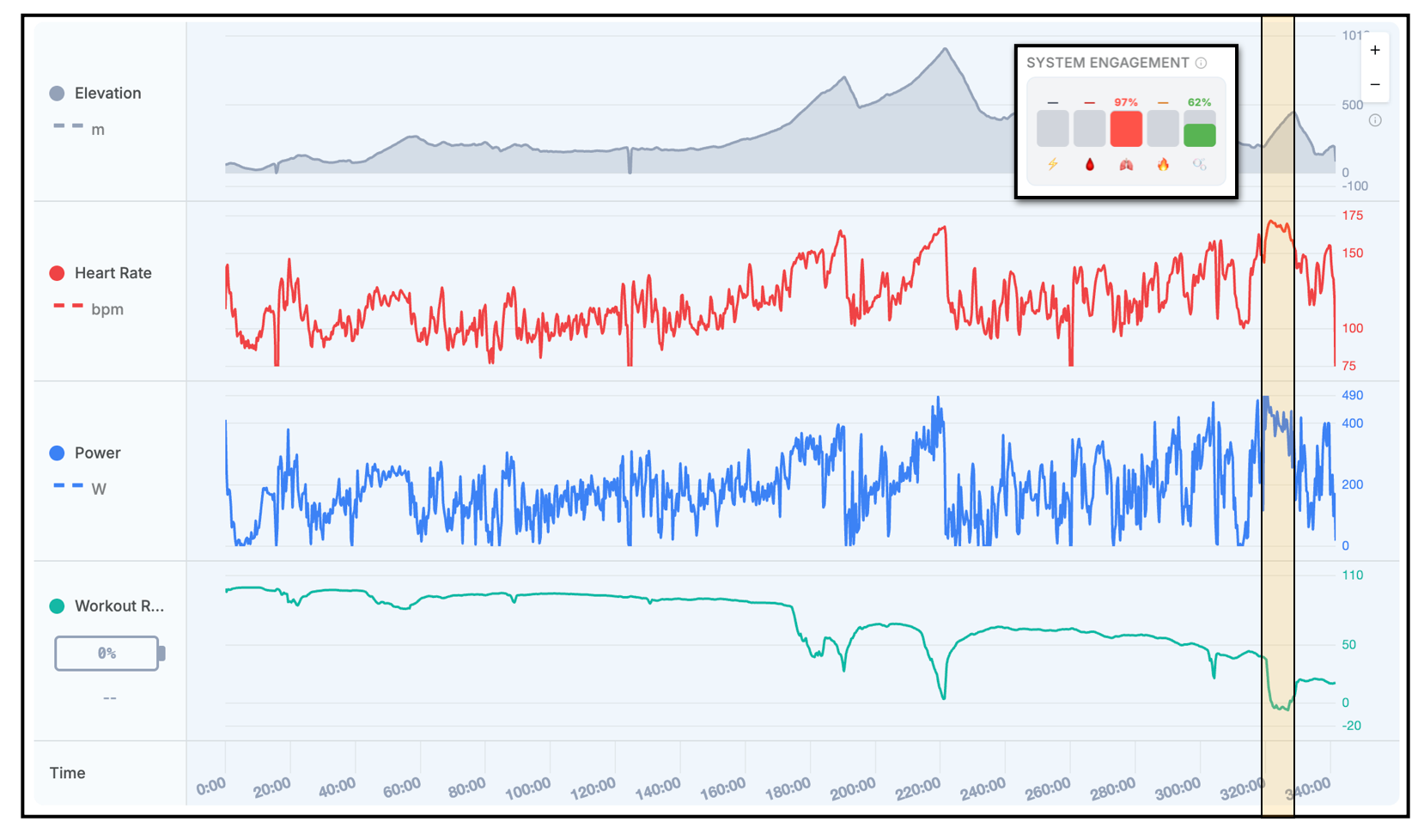
Example of the Athletica System Contribution for a selected portion of a race. In this case, the VO2MAX system of this athlete was engaged at 97% and the aerobic base system was engaged at 62% of the individual’s max. This particular effort, therefore, is likely triggering a stimulus that will further drive adaptation across those two metabolic pathways.
Indeed, what’s particularly insightful about this categorization is that we can align the primary metabolic stressor with the physiological adaptation. In this context, adaptations are synonymous with training, which consists of a response triggered in your body to better absorb future stresses of a similar nature. In general, the body does not adapt randomly to the work, but to specific failure points.
Meet the new Athletica feature, built upon the backbone of the Workout Reserve, where System Engagement represents the acute stress of the session, and associated likely future adaptations. The key systems include:
⚡Neuromuscular: This is all about maximal motor unit recruitment and likely Type IIa/x fibre engagement. Phosphocreatine (PCr) is the predominant energy system. The stress acts as a powerful signal to the body to “get stronger and faster.”
🩸Anaerobic: This is typically the “pH crash” zone. The main adaptation comes from buffering: the body gets better at handling acidosis that comes along with high lactate concentrations. Signal for glycolytic enzyme capacity and pH buffering.
🫁 VO2MAX: The stressor is the “O2 delivery limit”. The body is limited by both the heart’s pump capacity and the muscular status. Strong signal for stroke volume and capillary branching.
🔥 Threshold: The body is teaching the fast fibers to behave more like aerobic fibers. Signal for more MCT transporters and mitochondrial density.
🫧 Aerobic: This is about mitochondrial efficiency and capillary density. Signals the body to rely more on fat oxidation.
Here, we present a series of cases, using Athletica’s System Engagement to assess the recent performances of professional cyclists performing at the Giro alongside their coach.
Case 1: Crosswind mayhem
Context: Baku-Khankendi Azerbaijan 2026, Stage 2.
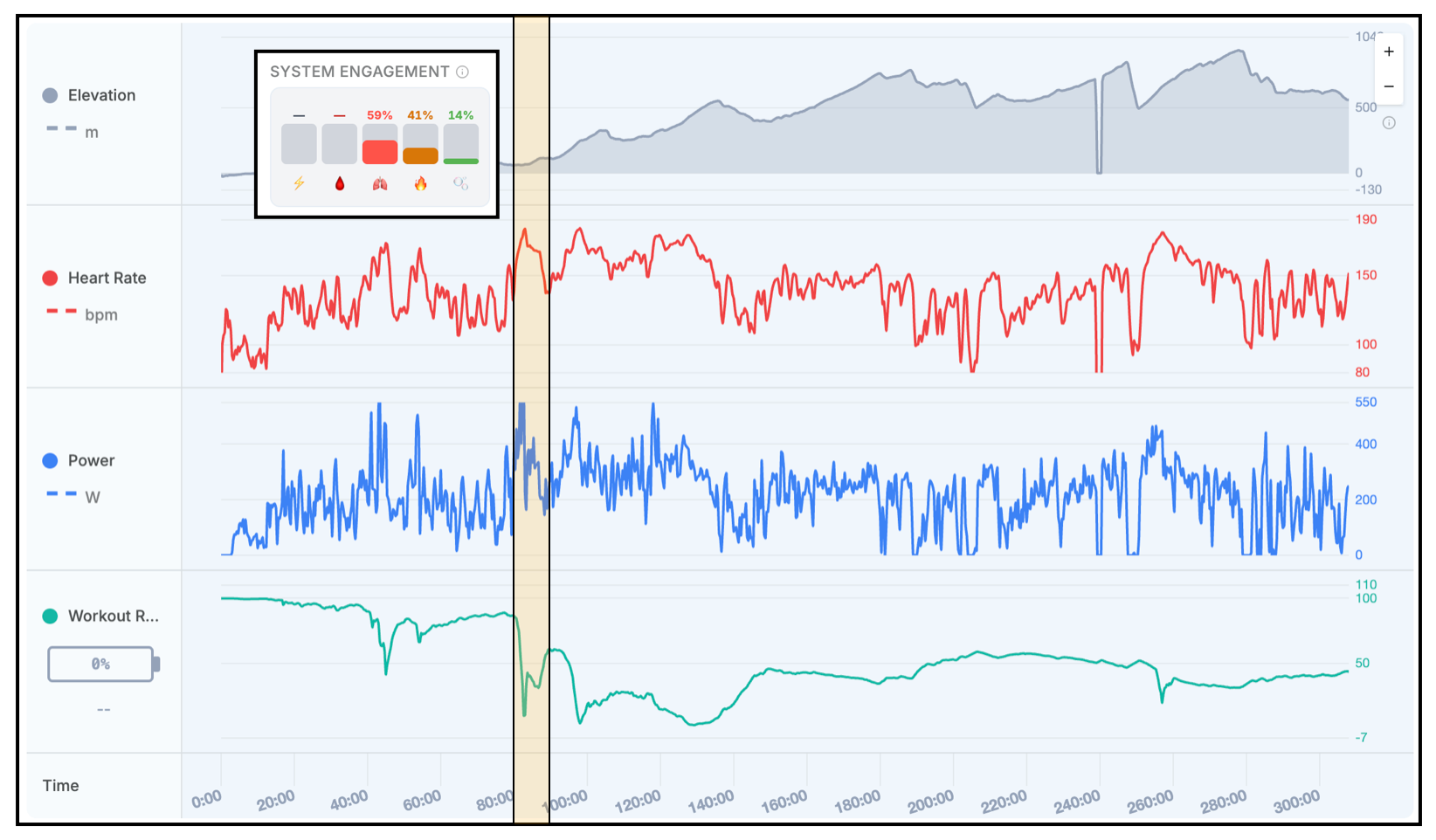
Athlete’s feedback: “At the beginning of the race, we turned before a short climb and the group split in the crosswinds. I lost the front group there and never managed to get back on. That effort basically blew me up and compromised the rest of my stage.”
Observations: When crosswinds happen, it is hard to follow the draft. In these cases, especially if it happens right before a climb, you might lose contact with those ahead of you, and you lose time and terrain. In this case, it happened a couple of times, and the resulting Athletica graphs using System Engagement tell the whole story.
Concomitant elevated engagement of the VO2MAX and Threshold pathways during the crosswind sector suggest that the athlete was pushing the body to its maximal oxygen processing and lactate clearance capacity. The low Workout Reserve values indicate that the rider burned quite a few matches on that climb.
Case 2: 170 km in the break away
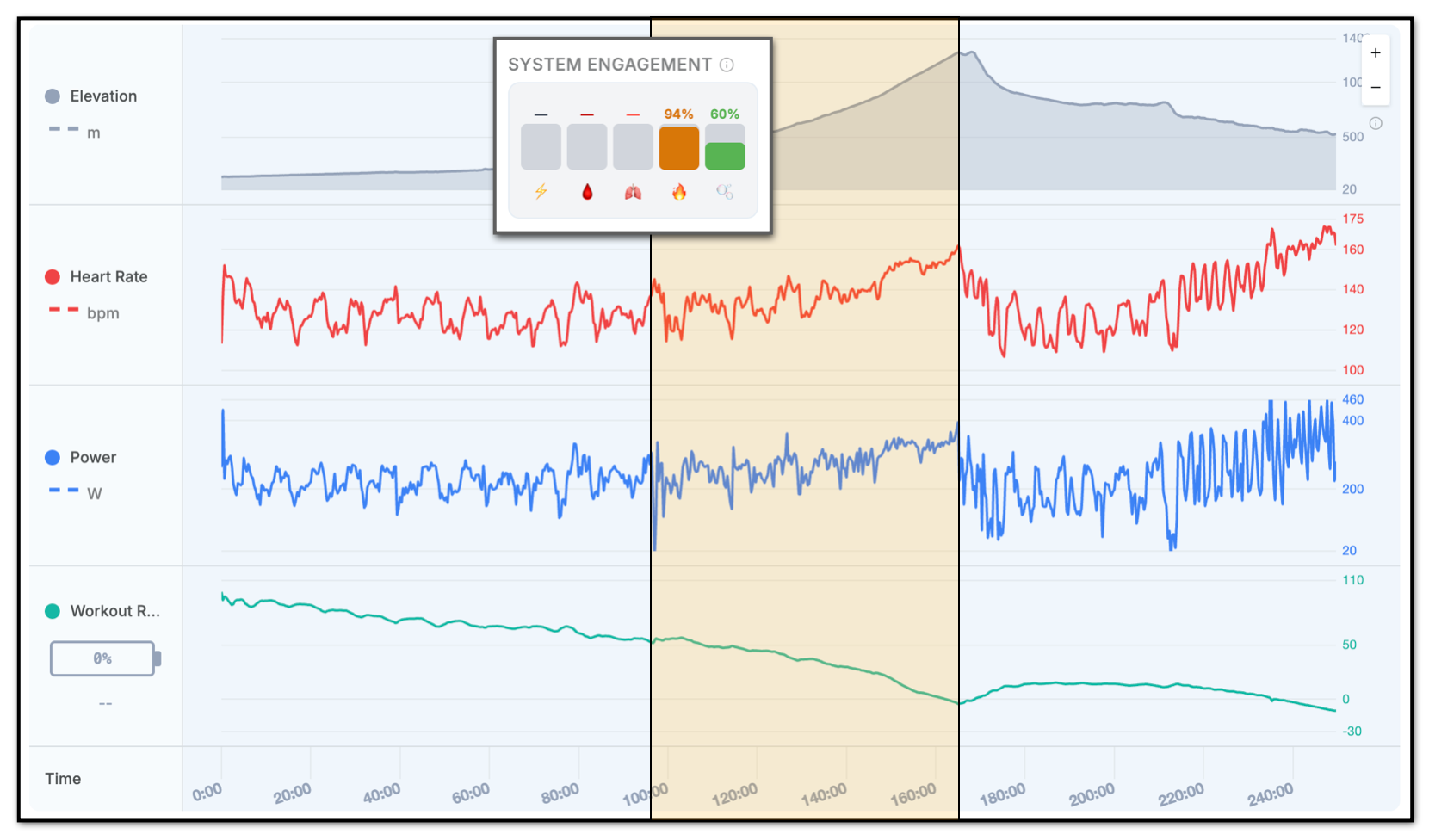
Context: Giro d’Italia 2026, Stage 3.
Observations: For this rider, high Threshold pathway engagement was detected. This effort likely saturated the athlete's aerobic and lactate clearance capacity. The sub-0 Workout Reserve values indicate that the rider was pushing beyond their historical maximum performance.
Case 3: Winning sprint!
Context: the final sprint of the Baku-Khankendi Azerbaijan 2026, Stage 4th.
Athlete’s feedback: “In the finale, I managed to find a good position and gave everything in the last few meters.”
Observations: During the sprint, high neuromuscular engagement was expected. This long sprint kept the glycolytic engine running at such a high % that it was likely making [La] and H+ flood the muscle, causing the pH to crash. In this case it was all worth it :)
The Workout Reserve matched exactly 0% at the end of the sprint, indicating that the rider matched their personal best historical performance on that particular time-duration.
Case 4: Pushing hard with the best of the best
Context: Final climb of the Giro d’Italia 2026, Stage 2nd.
Athlete’s feedback: “On the final climb, when the GC contenders launched their attack, I wasn’t able to respond.”
Observations: The analysis reveals high engagement of the VO2MAX pathway, which likely indicates that the athlete was pushing both the aerobic and anaerobic systems to their limit.The low Workout Reserve values close to 0% and the extremely high stresses clearly indicate that the cyclist was giving all that they had.
Conclusions
These considerations are not only reserved for the big teams and pro athletes. Not anymore. Athletica allows you to build your power profile and compute your Athletica Workout Reserve for your own training and racing. Now, with the new “Athletica System Engagement” feature, you can reverse-engineer your efforts, and better understand what system was engaged in any instance of a training session or race. With this feature, we believe we can provide the most mechanistically-grounded estimation of metabolic stress available in the field today.
This is the tool that can answer the question: “What limited our performance today?” The Athletica System Engagement helps you turn a messy power file into a clear list of metabolic events (and adaptation signals).
This feature is available for those athletes with complete and reliable power or speed profiles. It can be evaluated by clicking Open your workout → Analysis → Open Advanced Metrics below Metrics.
A brief note on methodology
Athletica's System Engagement derives its estimates from external load markers. That includes power output for cyclists and pace for runners. We do not directly measure metabolic variables such as blood lactate, oxygen uptake, or muscle pH. The system engagement values represent model-based inferences, grounded in established power-duration physiology and the individual's historical performance profile. As with all such models, they are best interpreted as probabilistic estimates rather than direct metabolic measurements.
Acknowledgements
We are grateful to the Bardiani-CFS 7 Saber team and all the cyclists willing to share their stories and data with us. Front picture: Bardiani-CSF 7 Saber winning the sprint at the 4th stage of the Baku-Khankendi Azerbaijan 2026. Credits: Bardiani-CSF 7 Saber and Sprint Cycling.
References
Zignoli A, Giorgi A, Kolodziej F, Martinez-Gonzalez B, Leo P, Laursen PB. Tracking Performance Limits Using Multi-Timescale Maximal Mean Power Ratios. Eur J Sport Sci. 2026 https://onlinelibrary.wiley.com/doi/10.1002/ejsc.70179
Gastin PB, Suppiah HT. Anaerobic and Aerobic Energy System Contribution During Maximal Exercise: A Systematic Review. Sports Med. 2026 Apr 11. doi: 10.1007/s40279-026-02414-7. Epub ahead of print. PMID: 41965479.
Klaris MB, Cubel C, Bruun TR, Stampe D, Rørvik S, Fischer M, Bonne T, Christensen PM, Piil JF, Nybo L. Performance and Fatigue Patterns in Elite Cyclists During 6 h of Simulated Road Racing. Scand J Med Sci Sports. 2024 Jul;34(7):e14699. doi: 10.1111/sms.14699. PMID: 39011951.
Ørtenblad N, Zachariassen M, Nielsen J, Gejl KD. Substrate utilization and durability during prolonged intermittent exercise in elite road cyclists. Eur J Appl Physiol. 2024 Jul;124(7):2193-2205. doi: 10.1007/s00421-024-05437-y. Epub 2024 Mar 5. Erratum in: Eur J Appl Physiol. 2024 Jul;124(7):2207-2208. doi: 10.1007/s00421-024-05479-2. PMID: 38441690; PMCID: PMC11199313.
Röhrs G, Keller S, Wahl P. Durability in Youth Squad Triathletes-Influence of Strenuous Cycling on Subsequent Running Performance, Economy, and Substrate Utilization. Int J Sports Physiol Perform. 2025 May 14;20(7):907-917. doi: 10.1123/ijspp.2025-0009. PMID: 40368324.

.png)