473 PRO and ELITE results across seven seasons show running is half a HYROX and the least decisive part. What the data says about how to train.
Half of a HYROX is running. Everyone knows that part.
What almost nobody knows is that running is also the discipline that separates top athletes the least.
Ludwig Rappelt and his group at the German Sport University Cologne scraped 473 4filtered PRO and ELITE results from the first seven seasons of the sport, then ranked every athlete twice. Once on total race time, once on each individual station. Running showed the smallest gap between those two rankings of anything on the course: 12.7% in men and 12.5% in women in season seven. Sled push was roughly double that.
Running remains vital, but the data suggests that in the PRO and ELITE fields, it is the discipline where athletes are most closely matched. If you can maintain a competitive pace when running, the true separation happens in the stations, where the ability to move heavy loads under deep fatigue becomes the primary differentiator.
I had Ludwig on the Training Science Podcast to walk through the paper, which was published in Frontiers in Physiology in July. What follows is what the data actually supports, what it doesn't, and where he's willing to speculate.
What the study looked at
Rappelt and colleagues pulled every PRO and ELITE result listed on the official HYROX results site from season one (2018/19) through season seven (2024/25). After removing duplicates, penalties, time bonuses and results with missing splits, they were left with 39,696 races: 27,854 male and 11,842 female. Of those, 473 were ELITE.
They deliberately excluded the OPEN category, which is 90 to 95% of all results. That's a limitation and a strength at the same time. What you get is a clean picture of what happens at the sharp end when a sport professionalises, and nothing at all about the median participant.
They also stripped out Roxzone time from the running analysis. Roxzone is the transit between the running loop and the station, and its length varies by venue, so including it would have made the running splits less accurate.
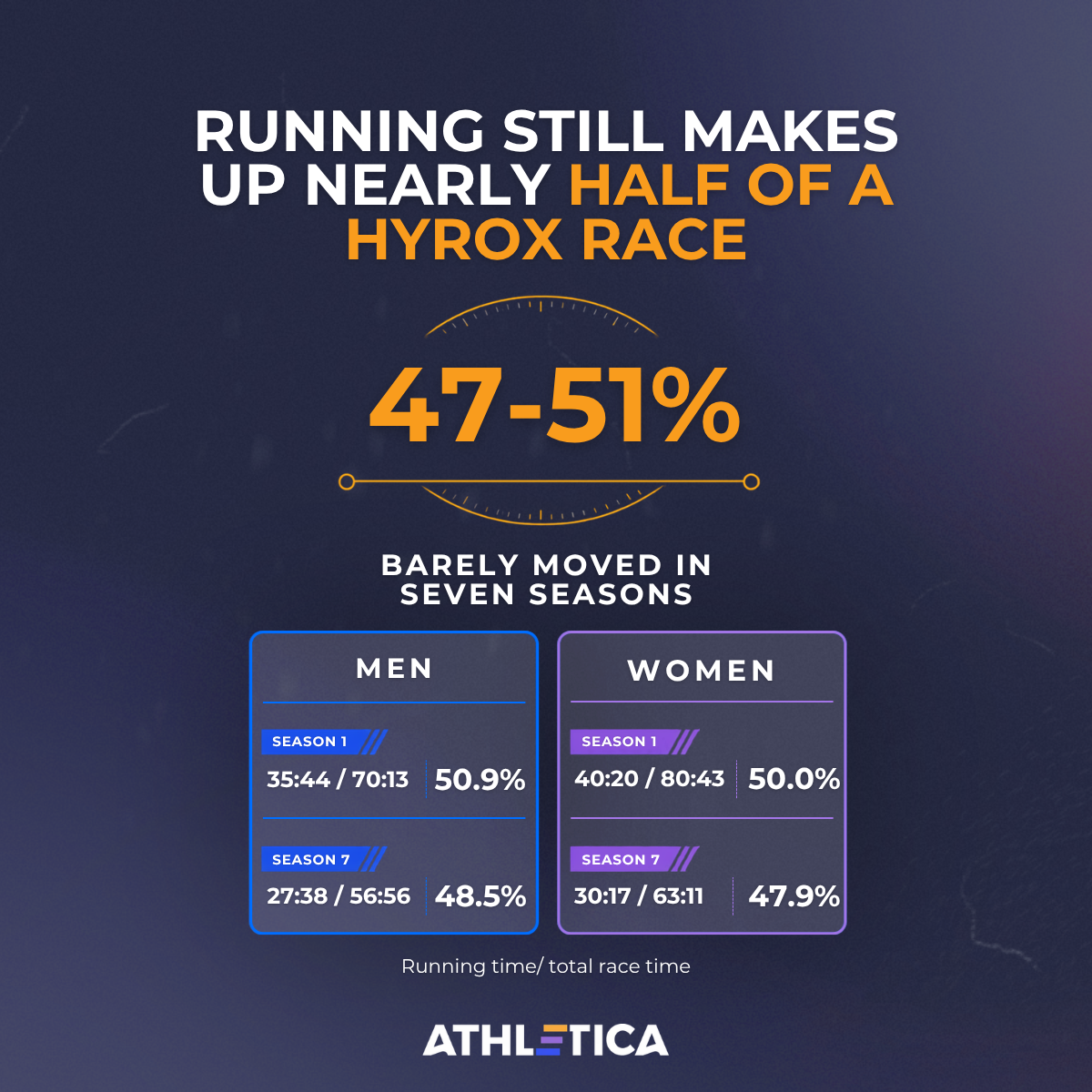
Data from the first seven seasons shows that running consistently occupies between 47 and 51% of the total clock. This ratio has remained remarkably stable, even as the field has significantly professionalised and found massive time gains.
Men’s PRO top 100: splits dropped from 35:44 in season one to 27:38 in season seven.
Women’s PRO top 100: splits improved from 40:20 down to 30:17 over the same period.
The conclusion is straightforward: while the volume of running makes it a vital performance pillar, there is a point of diminishing returns. Once you reach a threshold of competence, chasing extra mileage offers less value than addressing a weak station that triggers fatigue or forces an extended recovery period.
View your running as the primary engine; it must be powerful, but it means very little if the rest of the chassis fails under the specific loads of the course.
Where the field actually loses time
Here’s where the data becomes useful.
The researchers wanted to know whether each HYROX station affects faster and slower athletes in the same way. Their quantile regression analysis showed that it does not.
For elite athletes, the strength stations make a relatively small difference. Most can complete them without losing much time. For mid-pack and slower athletes, however, struggling with the sleds, sandbag lunges, or wall balls can add several minutes to the race.
The ranking data tells a similar story. Results varied considerably across the sled push, sled pull, SkiErg, farmers carry, and wall balls. Running performance was much more closely connected to overall finishing position.
Put simply, once you are strong enough to handle every station efficiently, HYROX becomes more of a running race. Until then, a weak station can quickly undo the advantage of being a good runner.
Rowing was especially interesting. Of all the individual stations, it had one of the strongest relationships with overall race performance in both men and women. In other words, athletes who performed well on the row also tended to finish the race faster.
The station that improved most isn't the one you'd guess
Male top 100 wall balls, season one: 6:06. Season seven: 3:55.
That's 36% off, proportionally more than running's 23%. Sled pull dropped 58 seconds. Burpee broad jump dropped 42 seconds.
Ski-erg moved only nine seconds in seven years.
Wall balls sit last on the course, right before the finish, and they're where fatigue collects. Ski-erg sits first, when everybody's fresh. So the station that improved most is the one most exposed to accumulated fatigue, and the one that improved least is the one that's least exposed to it. That suggests fatigue resistance rather than technique, where gains likely came from holding form when you're wrecked.
How strong do you need to be?
This is the question I get most, and the honest answer is that nobody has measured it yet.
Ludwig's estimate on the podcast, which he was careful to flag as speculation rather than finding: around 1.5 times bodyweight in the squat, and 90 to 100% of bodyweight on the bench. His group wants to test whether a genuine threshold exists and, more interestingly, whether there's a ceiling above which more maximal strength stops paying.
There's one descriptive data point worth putting next to it. Villarroel López and colleagues surveyed 80 active HYROX athletes and found 44% were squatting between 1.0 and 1.5 times bodyweight, and 45% were benching more than 100% of bodyweight, at a mean competition time of 1:11:15. So Ludwig's numbers are in the right postcode for a competitive field.
My read, and this is a view rather than a finding: the threshold is real and it's lower than most people training for HYROX believe. Dan Plews made the point well in our HIIT Science piece on HYROX strength: almost all the work on that course happens at a modest percentage of your one-rep max, under heavy fatigue. Getting stronger past the point where you can handle the loads buys you very little, and it costs you something, which brings us to the next question.
Is there a best bodyweight for HYROX?
The sled is 152kg for women and 202kg for men in PRO, on top of the sled's own weight. You need enough mass to move it. Ludwig's estimate is roughly 75 to 85kg for a male athlete, with the caveat that above 85 to 90kg the running penalty probably exceeds whatever the sled gives you back.
Again, speculation, and again there's one supporting data point rather than a body of evidence. Brandt and colleagues ran a simulated HYROX with 11 recreationally trained athletes and found VO2max positively correlated with performance and body fat inversely correlated.
Dan Plews is the useful worked example here. Coming from an Ironman background he had to go through a genuine hypertrophy phase to become competitive at HYROX, which is not a typical story you hear about an endurance athlete. The phenotype shift runs both directions, and it's slower than people expect.
Your rowing split is the biggest gap on the course
This one surprised me.
The male PRO top 100 rowed their 1000m in 3:48 in season seven. Women rowed 4:30. Hold those splits over 2000m and you land somewhere around 8:00 and 9:00.
The 2000m indoor rowing world records are 5:33.4 (Simon van Dorp, 2026) and 6:21.1 (Brooke Mooney, 2020).
That is a very large gap, and no other station on the HYROX course sits anywhere near that far from its specialist benchmark. HYROX runners are already respectable runners. HYROX rowers are not rowers.
Two honest caveats. First, the HYROX row happens after five kilometres of running and four stations, so you'd never expect a fresh 2000m equivalent. Second, athletes are pacing it to survive the back half of the race, not to maximise it. So the gap overstates the true capacity difference, but it doesn't erase it. Indeed, the rowing time in the top 100 has barely improved across seven seasons: 4:13 to 3:48 in men, against eight minutes off the run. Combine that with rowing having the highest independent explanatory value of any station in the quantile models, and there's a case that the field is systematically under-training the erg.
Half of HYROX athletes get hurt, and it's mostly the running
Two independent 2026 studies landed on the same picture.
Ketzer and colleagues surveyed 418 athletes and found 49.8% reported at least one HYROX-related injury in the preceding 12 months (95% CI 45.0 to 54.5). The knee was the most affected site at 20.8%, followed by spine and back at 15.2%. Where an injury could be attributed to a specific element of the sport, running was implicated in 27.6%, more than double the next entry, sandbag lunges at 11.8%. Williams and colleagues went further and ran a 12-week prospective cohort on 89 athletes. Weekly prevalence of health problems was 30% (95% CI 24 to 37), injury incidence was 14.4 per 1000 hours, and 73% of all injuries were overuse rather than acute. Knee again, at 22% of episodes.
Two different methods, two different samples, same answer. HYROX is an overuse sport and the running volume is doing most of the damage.
This sets up the obvious move. If rowing is the biggest performance gap on the course, and running is the biggest injury source, then shifting some of your aerobic volume from the road to the erg does two jobs at once. You get a real aerobic stimulus, you drop the eccentric loading on the knee, and unlike cycling or swimming, the thing you're cross-training on is literally a station in the race. The logic is clean and the downside is small.
So what do you actually do with this
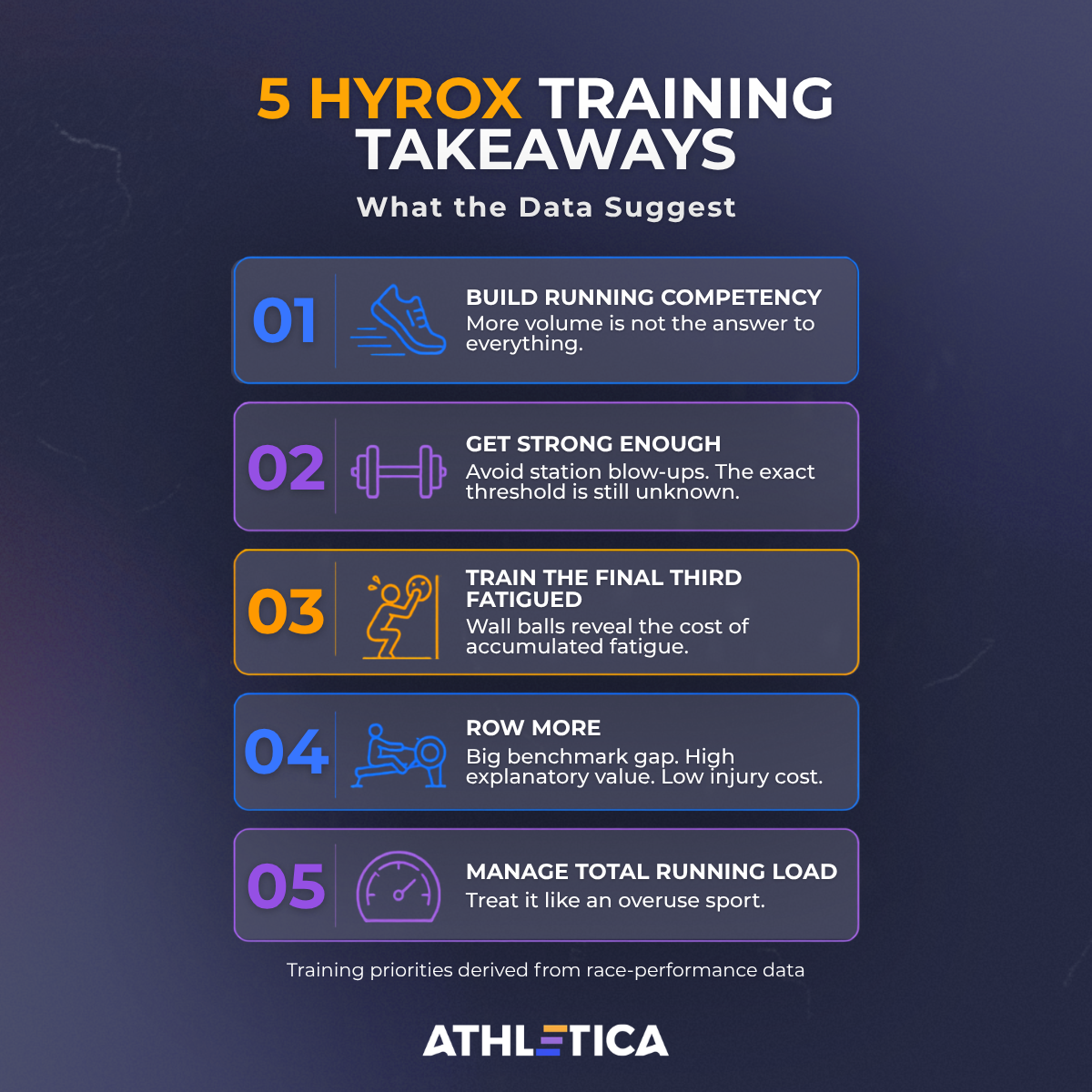
Training priorities derived from race-performance data
Five things follow from the data above, and I'll rank them by how confident I am.
Run enough to be competent, then stop treating running volume as the answer to everything. It's half the race and the least discriminating half. Confidence: high, this is straight from the reshuffling and quantile analyses.
Get strong enough that no station blows up on you, then stop. The quantile models are unambiguous that stations punish slower athletes disproportionately. Where exactly "strong enough" sits is not yet measured. Confidence: high on the principle, low on the number.
Train the last third of the race in a fatigued state. The wall ball data is the tell. The largest gains in seven seasons came from the station most exposed to accumulated fatigue. Confidence: moderate, this is my inference rather than the paper's conclusion.
Row more than you currently do. Biggest gap to benchmark, highest explanatory value, lowest injury cost. Confidence: moderate.
Manage your total running load like an overuse sport, because two independent 2026 studies say it is one. Confidence: high.
None of that is complicated. What's complicated is that the right balance is different for every athlete, and it moves week to week depending on what you've absorbed. A former CrossFitter and a former marathoner need close to opposite plans for the same race, and both of them need a different plan in week nine than in week two.
That's the problem Athletica exists to solve. The platform models your running load, tracks how you’re recovering, and moves the balance as your profile changes. It's built on the interval training principles Martin Buchheit and I set out in Science and Application of High-Intensity Interval Training, and it treats HYROX as the concurrent training problem it is rather than a running plan with sled work bolted on.
Your HYROX plan should fit you — not the athlete next to you.
Athletica adapts your strength and running balance week by week, based on your background, your load, and how you're recovering.
How much of a HYROX race is running? Between 47 and 51% of total race time, and that proportion has stayed stable across all seven seasons analysed. In the male PRO top 100 in season seven it was 48.5%, or 27:38 of a 56:56 finish.
How strong do you need to be for HYROX? Nobody has measured a true threshold yet. Ludwig Rappelt's working estimate is around 1.5 times bodyweight in the squat and 90 to 100% of bodyweight on the bench. Survey data on 80 competitive athletes found 43.8% squatting 1.0 to 1.5 times bodyweight, which is consistent with that estimate.
What VO2max do you need for HYROX? Nobody has measured this. No published study establishes a VO2max requirement for HYROX, so what follows is my estimate from the podcast conversation with Ludwig Rappelt and not a finding from any paper cited here. Around 60 to 65 ml/kg/min appears sufficient, possibly toward 70 at the elite end. Past that point, running economy and how fast you can raise oxygen uptake at the start of each running segment likely matter more than peak VO2max. Treat it as a working assumption until somebody tests it.
What is a good HYROX rowing time? The male PRO top 100 averaged 3:48 for 1000m in season seven, and women 4:30. Both sit a long way off specialist rowing benchmarks, which suggests the row is one of the more improvable stations on the course.
Which HYROX station costs the most time? It depends on how fast you are. Quantile regression shows the strength-based stations, particularly sandbag lunges and the sleds, cost slower athletes disproportionately more time than they cost elites. For fast athletes the race is decided by running.
Is HYROX getting faster? Substantially. PRO top 100 total times improved by about 13 minutes in men and 17 minutes in women between seasons one and seven. ELITE median times went from 1:06:24 to 0:57:17 in men and 1:11:09 to 1:03:22 in women, while the coefficient of variation between elite results fell from over 10% to under 5%.
References
Rappelt L, Wiedenmann T, Held S, Heinke L, Micke F, Wicker P, Donath L. Longitudinal performance development in PRO and ELITE HYROX competitions across the first seven competitive seasons. Front Physiol 2026;17:1847569. doi:10.3389/fphys.2026.1847569
Brandt T, Ebel C, Lebahn C, Schmidt A. Acute physiological responses and performance determinants in Hyrox, a new running-focused high intensity functional fitness trend. Front Physiol 2025;16:1519240. doi:10.3389/fphys.2025.1519240
Ketzer C, Kirstein L, Bonleitner M, Beyerle P, Zehnder P, Schwarz M, Biberthaler P, Zyskowski M. Injury epidemiology in HYROX athletes: an international cross-sectional survey. medRxiv 2026. doi:10.64898/2026.08.09.26359590
Williams et al. Prevalence, burden and risk markers of health problems in HYROX athletes: a 12-week prospective cohort study. Front Sports Act Living 2026. doi:10.3389/fspor.2026.1937574
Villarroel López P, Agudo-Ortega A, Juárez Santos-García D. Characterization of the profile of Hyrox athletes. Appl Sci 2025;15(21):11693. doi:10.3390/app152111693
Laursen PB, Buchheit M. Science and Application of High-Intensity Interval Training. Human Kinetics, 2019.