HYROX Nutrition Guide: What to Eat Before, During and After Your Race
September 8, 2026
Paul Laursen
HYROX nutrition explained: Learn what to eat before and during a 90-minute race, whether you need carb loading or gels, and what really drives performance.
The average HYROX takes about 86 minutes and burns through several hundred grams of carbohydrate.
You can carry maybe 50 of those grams in your race belt. At 92% of maximum heart rate, with blood shunted away from your gut and a 202kg sled in front of you, you'll absorb a fraction of what you swallow.
So the mid-race fuelling plan you've been sold is trying to solve a problem it has no way of solving.
I’ve spent the past 20 years looking at fueling from different angles. As a younger triathlete, I built an app called NeverBonk that calculated how many grams of carbohydrate per hour an athlete “needed.” Later, I published research on low-carbohydrate approaches and coached athletes using them.
My thinking has changed along the way, and I haven’t always gotten it right. What follows is where I’ve landed for this particular race and duration, with a clear distinction between what the evidence supports and where it remains limited.
For HYROX specifically, the evidence is still very limited. There are no fueling trials in HYROX athletes yet, so the recommendations that follow are drawn from research in similar endurance events.
What a HYROX actually does to you
Brandt and colleagues at the University of the Bundeswehr Munich ran the first physiological study on HYROX in 2025. Eleven recreational athletes, full Individual Open simulation, heart rate and blood lactate measured after every run and every station.
Median finish: 86.5 minutes. Running took 51.2 of those minutes, stations 32.8.
The intensity numbers are what matter here. Athletes spent 79.5% of the race between 90 and 100% of maximum heart rate, and another 19.6% between 70 and 90%. Average heart rate was 170.9 against a max of 186. Average blood lactate across the race was 6.3 mmol/L, peaking at 8.5 after the stations and 7.7 after the runs. RPE hit 18 on the stations.
The other finding was about who goes fast. VO2max was the strongest correlate of finish time (rho = -0.71), endurance training volume next (-0.68) and body fat percentage after that (+0.67). Grip strength, muscle mass percentage, and resistance training volume showed no meaningful relationship with finishing time.
It’s a small study with only 11 athletes, so the results should be interpreted carefully. Still, the overall pattern is consistent with what Ludwig Rappelt’s group found across nearly 40,000 results, which I covered last month.
The thing that separates fast athletes from slow ones isn't carbohydrate
In 2015 I published a study with Ken Hetlelid, Dan Plews and Stephen Seiler that I've thought about more or less constantly since. We took nine well-trained runners (VO2max 71) and nine recreationally trained runners (VO2max 55) and put both groups through the same self-paced interval session: six by four minutes on a 5% treadmill grade, two minutes recovery.
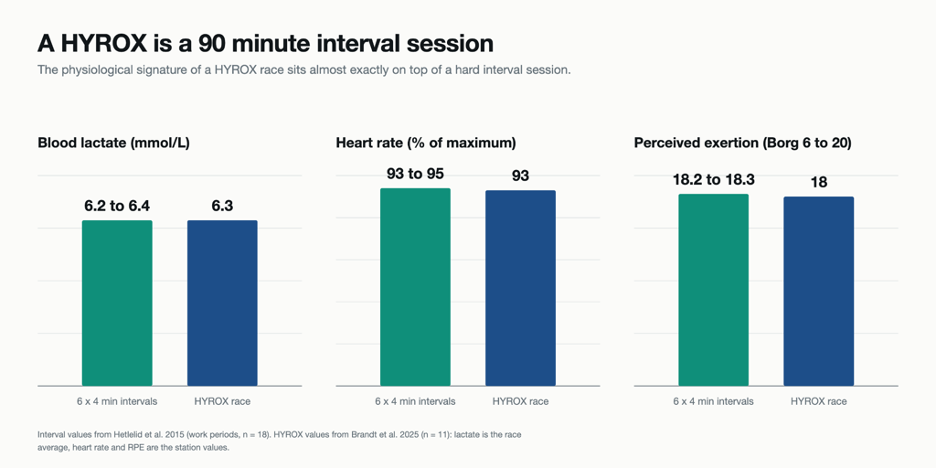
Look at what the two groups had in common. RPE 18.3 versus 18.2. Blood lactate 6.4 versus 6.2 mmol/L. Peak heart rate 93 to 95% of max in both groups.
Now compare that to a HYROX. Lactate 6.3. Heart rate 92% of max across the race and 93% during the stations. RPE 18. The physiological signature of a HYROX is, near enough, a 90-minute version of that interval session.
Figure 1. Blood lactate, heart rate and perceived exertion in a hard interval session compared with a HYROX race. Interval values from Hetlelid et al. 2015 (n = 18, work periods). HYROX values from Brandt et al. 2025 (n = 11); lactate is the race average, heart rate and RPE are the station values.
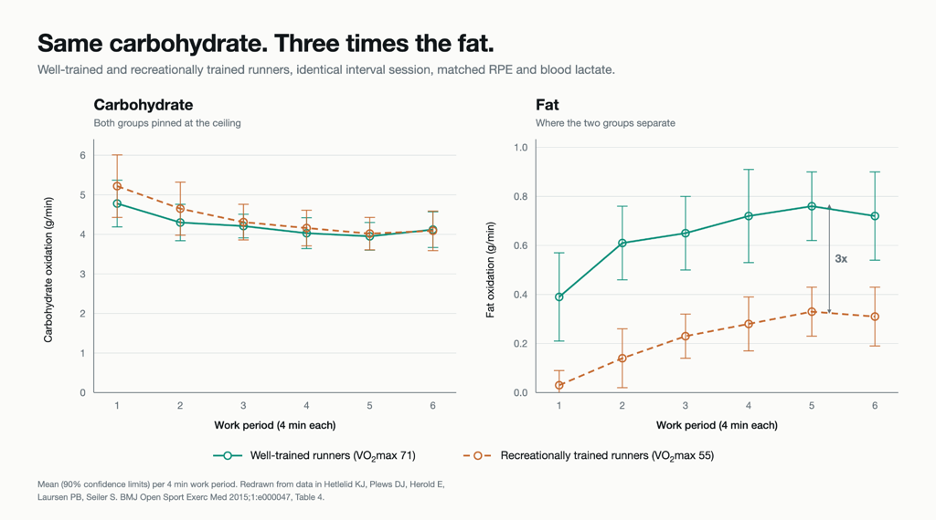
Here's what we found in the laboratory study. Carbohydrate oxidation was identical between the two groups: 4.2 g/min in the well-trained, 4.4 g/min in the recreational. No meaningful difference. Everybody was maxed out.
Fat oxidation was 0.64 g/min in the well-trained and 0.22 g/min in the recreational. Nearly three times higher. Fat supplied 33% of total energy in the well-trained group against 16% in the recreational one. And the correlation between fat oxidation rate and VO2max was 0.86, while the correlation between carbohydrate oxidation and VO2max was -0.20 and unclear.
The better athletes weren't burning more carbohydrate. They couldn't. Carbohydrate oxidation has a ceiling and both groups were sitting on it. What the faster athletes were doing was burning fat on top of it, at an intensity where most textbooks say fat oxidation is negligible.
Figure 2. Carbohydrate and fat oxidation across six 4 min work periods in well-trained and recreationally trained runners, mean and 90% confidence limits. Averaged across the six periods these give the 4.2 and 4.4 g/min for carbohydrate and the 0.64 and 0.22 g/min for fat quoted above. Redrawn from Hetlelid et al. 2015, Table 4.
Two honest caveats before anyone runs with this. First, it's cross-sectional, nine per group. Fat oxidation capacity travels with VO2max and training history, so I can't tell you from this study that raising fat oxidation independently makes you faster. Second, indirect calorimetry above 85% VO2max is contested, because bicarbonate buffering inflates CO2 output. That error runs in the direction of underestimating fat oxidation, not overestimating it, so if anything we were conservative. But it's a real limitation and I'd rather say it than have someone else say it for me.
So what are race-day carbs actually for?
They're for one job, and it's a real one.
Tim Noakes, Andrew Koutnik and colleagues published a review in Endocrine Reviews this year that reorganises how I think about this. The argument is that we've spent fifty years focused on the wrong glucose pool.
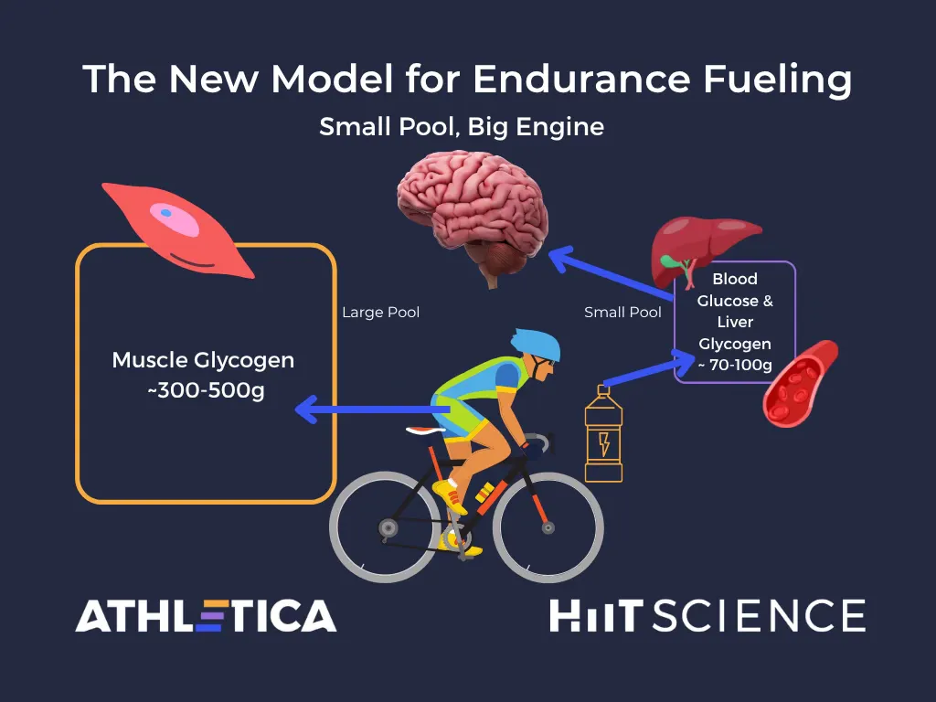
The large pool is muscle glycogen, several hundred grams, and it's what carb loading targets. The small pool is liver glycogen plus circulating blood glucose, roughly 100 to 130 grams total. During exercise your liver pushes out glucose at around 60 g/h, and that rate doesn't slow down as the pool empties.
The review's case is that when carbohydrate ingestion improves endurance performance, it does so by preventing that small pool from running down and blood glucose from falling. Not by refilling muscles. Nothing you drink can selectively refill a muscle mid-race anyway, whereas a small amount of sugar reverses a falling blood glucose in minutes.
As blood glucose begins to drop, the brain receives signals that energy availability is becoming limited. Effort starts to feel harder, and performance may decline even before blood glucose reaches clinically low levels.
Figure 3. Diagram comparing muscle glycogen (large pool) and blood glucose + liver glycogen (small pool), with arrows showing how fueling supplements energy flow to brain during endurance exercise. Noakes et al. Endocrine Reviews 2026.
For an 86-minute race this changes the whole calculation. Your legs are not going to run out. Your liver might, if you arrive with it half empty. That's a pre-race problem far more than a mid-race one, and the fix costs about 25 to 30 grams of carbohydrate rather than 700.
Now to the practical questions.
What should I eat before a HYROX race?
Something familiar, low in fibre and fat, two to three hours out. Around 1 to 1.5 g/kg of carbohydrate is plenty. For an 80kg athlete that's a bowl of oats with a banana, or rice and eggs, or toast and honey. Whatever you've eaten before hard sessions for the last three months.
The job of that meal is topping up your liver, not your legs. Which is why it doesn't need to be enormous, and why turning up to the start line feeling full is a straightforward mistake in a race where you spend 51 minutes running.
If your race is early and eating at 5am makes you gag, a smaller feed 60 to 90 minutes out does most of the same work.
Do I need to carb-load the week of a HYROX?
No. And most of what's published on this is copied straight out of marathon guidelines without anybody checking whether it applies.
Have a look at what's out there. The mainstream recommendation runs 6 to 8 g/kg, some sites escalate to 7 to 12 g/kg the day before, and one popular HYROX protocol calls for roughly 4 g per pound of bodyweight, which is about 700 grams for a 79kg athlete.
Two problems with that.
The first is that the performance benefit was never there, even in longer events. Sherman and colleagues showed back in 1981 that the classic depletion-loading protocol produced no faster 21km times than simply eating a high-carbohydrate diet for three days. Their finishing times were actually slower in the higher-glycogen trials. Their own conclusion was that anything above a minimal level of muscle glycogen is unnecessary for a given intensity and duration. In 2000 Burke, Hawley, Noakes and colleagues ran a properly placebo-controlled carb-loading trial over 100km of cycling, which is five to seven times longer than a HYROX, and found no performance benefit.
The second is that loading isn't free. Every gram of glycogen carries water with it. You are adding two or three kilograms of body mass to a race where 60% of your time is spent running and where body fat percentage already correlated with finish time in the only physiological study anyone has run on this sport.
Eat normally throughout race week. If it helps you feel more prepared, add a little extra carbohydrate during the final two or three days. There’s no need to force down an enormous pasta dinner the night before.
Do I need gels during HYROX?
Under about 75 minutes, no. Your liver has enough for that if you ate breakfast.
Between 75 and 120 minutes, one small feed is reasonable insurance. Not to add fuel, which as we've covered isn't really possible at that intensity, but to keep blood glucose from drifting down late in the race.
Over two hours, yes, and take it in small regular amounts rather than one heroic dose.
The dose is where I part company with most of the field. The standard advice is 30 to 60 g/h and some HYROX protocols recommend two full gels. On the evidence in the Endocrine Reviews review, the amount required to protect blood glucose is far smaller than the amount required to "fuel" a race, and the low doses tested in the literature do the job about as well as the high ones. For a 90-minute HYROX, one gel is the ceiling of what I'd take, not the floor.
There's also a cost nobody mentions. Carbohydrate ingestion suppresses fat oxidation in a dose-dependent way. In a race where fat oxidation at high intensity is the thing separating the fast from the slow, drowning yourself in sugar is not obviously a neutral act.
When should I take my first gel?
Early, in the roxzone, somewhere around run three or four. Not saved for the wall balls.
This follows directly from the mechanism. You're preventing a decline, not reversing one. By the time you feel the wheels coming off, blood glucose has already been falling for a while and your output has already dropped. Insurance you buy after the crash isn't insurance.
Honestly, if you're only going to take one thing, the highest-value feed is 10 to 15 minutes before the gun rather than anything mid-race. Absorption is better standing still than it is between a farmers carry and a 1km run.
And use something you've used in training. I shouldn't have to say this and yet every race weekend somebody tries a new gel from the expo goodie bag.
What if I'm racing in the afternoon or evening?
This is the biggest unforced error in HYROX and almost nobody writes about it, because the advice has all been imported from marathons, which start in the morning.
HYROX heats run all day. If you're off at 4pm and you follow standard "eat 3 hours before" advice while otherwise treating race day as a fasting day, you'll arrive at the start line with a liver that's been drawn down since breakfast and nerves on top of it.
Eat normally. Breakfast as usual. A normal lunch about three hours out. Something small and familiar 60 to 90 minutes before your heat. Then stop.
What you want to avoid is the other failure mode, which is grazing on gels and sports drinks for six hours out of anxiety and starting the race bloated with a gut full of sugar it hasn't cleared.
How much caffeine, and when?
Around 3 mg/kg, 45 to 60 minutes before your heat, from a source you already use. For most people that's a strong coffee or a 200mg tablet.
Caffeine works on perceived effort and central drive. Given RPE hits 18 on the stations, shaving something off how bad that feels is worth having. It does nothing for fuel availability, so don't confuse the two.
What I'd avoid is stacking a loaded pre-workout on top of race adrenaline. Your heart rate is already going to sit at 90 to 100% of max for most of the race. There's no headroom there to buy.
Why do I cramp on the lunges and wall balls, and can nutrition fix it?
Probably not, and the entire electrolyte industry built around this question is standing on very little.
The evidence has been consistent for forty years. Maughan compared marathon runners who cramped with those who didn't and found no differences in serum electrolytes or plasma volume. Schwellnus and colleagues found the same in Two Oceans runners and in Ironman triathletes. Hoffman and Stuempfle followed 161km ultra runners and found extra salt during the race made no difference to cramping. In experimental work, people cramp when fully hydrated and electrolyte-supplemented.
What does predict cramping is racing harder or further than you've trained for, a previous history of cramping, and markers of muscle damage.
The current explanation, largely Martin Schwellnus's work, is that cramps come from altered spinal reflex activity in fatigued muscle. The inhibitory signal from the Golgi tendon organ drops off while the excitatory signal from the muscle spindle stays high, and the muscle locks up. It's worst in muscles contracting repeatedly in a shortened position.
Which is a fairly exact description of sandbag lunges and 100 wall balls at the end of a HYROX.
Rather than leaning on extra electrolytes, address pacing and preparation. Rehearse the functional movements in a fatigued state, and resist opening the run ten seconds per kilometer faster than your habitual training pace. Should a cramp lock up the muscle, pause to stretch it out. Gentle lengthening inhibits the motor neuron drive rapidly, whereas swallowing an electrolyte pill won't fix the problem.
What should I eat after a HYROX?
Whatever you like, and then eat properly for the rest of the day.
The 30-minute window is oversold. It came from studies in athletes training twice a day who needed to be functional again in eight hours. You just did an 86-minute race. Liver glycogen recovers quickly once you eat, and muscle glycogen has all week if you're not racing again tomorrow.
Total daily protein is the piece worth being deliberate about, somewhere around 1.8 g/kg across the day, spread out rather than dumped into one shake.
The part I'd actually push on: don't treat the finish line as a licence to eat garbage. One race won't hurt you. But the pattern I see over and over is athletes who train hard, race hard, and use both as permission for a diet that leaves them fit and metabolically unhealthy at the same time. Phil Maffetone and I wrote about that phenotype a decade ago and it hasn't got rarer. If fat oxidation at high intensity is what separates HYROX athletes, and food quality is one of the levers on it, then what you eat on the 51 weeks you're not racing matters more than the meal after the finish line.
What are the most common HYROX nutrition mistakes?
Ranked by how much time I think they cost.
Turning up metabolically unprepared and trying to fix it in race week. This is the big one and it's not really a nutrition mistake, it's a twelve-month one.
Carb loading for a fuel crisis that isn't going to happen, and carrying the extra water weight through 8km of running.
Taking gels you've never trained with, in quantities designed for a five-hour bike ride.
Fasting all day before an afternoon heat because you're nervous.
Treating cramp as an electrolyte problem and never addressing the pacing and preparation that actually cause it.
Drinking to a schedule rather than to thirst, which is a separate article but the short version is that the fluid guidelines have been overstated for decades.
Want the training side handled properly?
Athletica's HYROX plans build the threshold and aerobic base your race demands — and adapt the running and strength balance week by week based on what you're actually absorbing.
Build threshold speed and aerobic volume in the months before the race. This is the lever that moves your finish time and everything else here is rounding error next to it. Confidence: high, from both Brandt and our own pilot.
Eat a normal, familiar, low-fibre meal two to three hours out, and don't load. Confidence: high on not loading, which has failed in controlled trials over both 21km and 100km. Moderate on the exact timing, which is practical convention rather than tested.
Take one small carbohydrate feed if you'll be out longer than 75 minutes, early rather than late. Confidence: moderate. The mechanism is well supported, the dose and timing for a 90-minute high-intensity event are extrapolated.
Stop buying electrolytes to solve cramping. Confidence: high. This has been tested repeatedly and it doesn't hold up.
Improve the quality of what you eat year-round if you want to raise fat oxidation at high intensity. Confidence: moderate on the mechanism, low on the size of the effect, because nobody has run the trial in this population. Which brings me to the last thing.
We're actually testing this
Everything above is reasoned transfer from studies in runners, cyclists and triathletes. Nobody has run a fuelling trial in HYROX athletes, and until somebody does, my recommendations and the ones you'll read elsewhere are both arguments rather than findings. Mine at least tells you which.
That's why we started the FIELD study. Fueling Influence on Endurance Load and Development pairs a 15-minute nutrition survey with the training data you're already collecting in Athletica, so we can look at how long-term fuelling patterns relate to threshold, fatigue resistance and recovery across months rather than across two lab visits. It's guided by Tim Noakes, Phil Maffetone, Jeff Volek, Andrew Koutnik and Philip Prins, and the point is to settle the argument with data from real athletes rather than another round of opinions.
If you're training for HYROX and you eat any way at all, high-carb, low-carb or somewhere in the middle, you're eligible.
What should I eat before a HYROX race? A familiar, low-fibre, low-fat meal two to three hours before your heat, containing roughly 1 to 1.5 g/kg of carbohydrate. For an 80kg athlete that's about 80 to 120g, so oats and a banana rather than a full pasta plate. The purpose is topping up liver glycogen, not muscle glycogen.
Do I need to carb-load for HYROX? No. Carb loading failed to improve performance in a placebo-controlled 100km cycling trial and produced no benefit over 21km of running in the original 1981 study. A HYROX takes about 86 minutes. You'd be adding two to three kilograms of glycogen-bound water to a race that's half running.
Do I need gels during a HYROX race? Under 75 minutes, no. Between 75 and 120 minutes, one gel is reasonable insurance against blood glucose falling late in the race. Over two hours, take small amounts regularly. The purpose is protecting blood glucose, not adding fuel, so the dose needed is smaller than standard endurance guidelines suggest.
When should I take my first gel in HYROX? Early, in the roxzone around run three or four, rather than saving it for the wall balls. You're preventing a decline in blood glucose, and once you feel it, output has already dropped. A feed 10 to 15 minutes before the start is arguably more useful than anything taken mid-race.
What should I eat if my HYROX heat is in the afternoon? Eat normally all day. Breakfast as usual, a normal lunch around three hours before your heat, something small and familiar 60 to 90 minutes out, then stop. Don't fast all day on nerves and don't graze on gels for six hours.
How much caffeine should I take before HYROX? Around 3 mg/kg, 45 to 60 minutes before your heat, from a source you already use in training. It works on perceived effort rather than fuel availability. Avoid stacking a heavy pre-workout on top of race adrenaline.
Can electrolytes stop me cramping in HYROX? Almost certainly not. Studies comparing athletes who cramp with those who don't consistently find no difference in serum electrolytes or hydration status, and extra salt didn't reduce cramping in a 161km ultramarathon. Cramping is better predicted by racing harder than you've trained, previous cramp history and muscle damage. Stretch the muscle, pace the race and rehearse the stations under fatigue.
What should I eat after HYROX to recover? Something you enjoy, then eat properly for the rest of the day. The 30-minute window matters when you're training again in eight hours, which after a race you aren't. Total daily protein of around 1.8 g/kg is the more useful target.
What are the most common HYROX nutrition mistakes? Trying to fix twelve months of poor food quality in race week, carb loading for a fuel crisis that doesn't happen in 90 minutes, using untested gels in quantities designed for a five-hour ride, fasting before an afternoon heat, and treating cramp as an electrolyte problem.
References
Brandt T, Ebel C, Lebahn C, Schmidt A. Acute physiological responses and performance determinants in Hyrox, a new running-focused high intensity functional fitness trend. Front Physiol 2025;16:1519240. doi:10.3389/fphys.2025.1519240
Hetlelid KJ, Plews DJ, Herold E, Laursen PB, Seiler S. Rethinking the role of fat oxidation: substrate utilisation during high-intensity interval training in well-trained and recreationally trained runners. BMJ Open Sport Exerc Med 2015;1(1):e000047. doi:10.1136/bmjsem-2015-000047
Noakes TD, Prins PJ, Buga A, D'Agostino DP, Volek JS, Koutnik AP. Carbohydrate ingestion on exercise metabolism and physical performance. Endocr Rev 2026;bnaf038. doi:10.1210/endrev/bnaf038
Sherman WM, Costill DL, Fink WJ, Miller JM. Effect of exercise-diet manipulation on muscle glycogen and its subsequent utilization during performance. Int J Sports Med 1981;2(2):114-118.
Burke LM, Hawley JA, Schabort EJ, St Clair Gibson A, Mujika I, Noakes TD. Carbohydrate loading failed to improve 100-km cycling performance in a placebo-controlled trial. J Appl Physiol 2000;88(4):1284-1290.
Schwellnus MP, Nicol J, Laubscher R, Noakes TD. Serum electrolyte concentrations and hydration status are not associated with exercise associated muscle cramping (EAMC) in distance runners. Br J Sports Med 2004;38(4):488-492.
Hoffman MD, Stuempfle KJ. Muscle cramping during a 161-km ultramarathon: comparison of characteristics of those with and without cramping. Sports Med Open 2015;1(1):24.
Miller KC, McDermott BP, Yeargin SW, Fiol A, Schwellnus MP. An evidence-based review of the pathophysiology, treatment, and prevention of exercise-associated muscle cramps. J Athl Train 2022;57(1):5-15.
Maffetone PB, Laursen PB. Athletes: fit but unhealthy? Sports Med Open 2016;2:24. doi:10.1186/s40798-016-0048-x
Rappelt L, Wiedenmann T, Held S, Heinke L, Micke F, Wicker P, Donath L. Longitudinal performance development in PRO and ELITE HYROX competitions across the first seven competitive seasons. Front Physiol 2026;17:1847569. doi:10.3389/fphys.2026.1847569