July 17, 2025
Automatic Interval Detection: From Theoretical Models to Real-World Performance Before joining Athletica, I spent years in the exciting world of Theoretical Physics, working on string theory and early-universe models. It was intellectually rewarding—but abstract. What I found in sport science was something different: a direct connection between data, analysis, and tangible human performance. Working with […]
Before joining Athletica, I spent years in the exciting world of Theoretical Physics, working on string theory and early-universe models. It was intellectually rewarding—but abstract. What I found in sport science was something different: a direct connection between data, analysis, and tangible human performance.
Working with athlete data brings its own complexity—just like theoretical physics—but it’s grounded, practical, and immediately impactful. Instead of equations that take years to validate experimentally (in the best case scenario), performance data offers real-time feedback. That immediacy drew me in.
The idea behind our new feature was quite simple:
Can we automatically detect steady-state and short maximal efforts (“Intervals”) — whether planned or spontaneous?
The answer, now live in Athletica, is Interval IQ™.
Automatically identifying efforts—independent of workout plans or manual lap marks—brings major benefits:
Timestamp guide
TimeTopic0:00 – 0:30Why we tackled automatic interval detection & how it differs from Intervals.icu0:31 – 1:21Algorithm finds all intervals, not just the “best” ones1:22 – 2:4430/30 example – capturing the true 26 s work-bout2:45 – 3:09Benefits for indoor structured workouts & compliance scoring3:10 – 3:59Outdoor application & analysing unstructured sessions (races, fondos)4:00 – 4:27My flat 70.3 case study – 10-11 power-stable blocks4:28 – 5:00Why minimising spikes matters for race execution
You: A self-coached athlete—or a coach managing a dozen riders.Your goal: Train smart, track progress, hit race day ready.Your challenge: Ride data is messy. Outdoor sessions are rarely clean. Planned efforts get interrupted. Laps don’t tell the whole story.
Interval IQ™ turns session chaos into a clean, structured list of detected intervals—planned or accidental—so every watt has context.
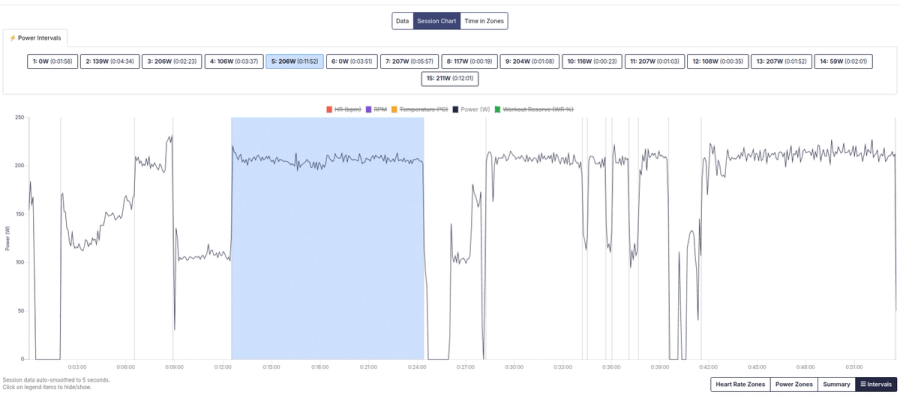

Figure 1A: Athletica’s Interval IQ automatically finds and displays your intervals so you don’t have to hunt for them. 1B: You can zoom in on any interval to display its data.
Pain PointBefore Interval IQAfter Interval IQHidden sprint PBsBuried in 20,000 data pointsAuto-surfacedVO₂ lapsMisleading averages from slow start or overextended end26s–33s real bout detectedOutdoor variabilityLap data not always reflective of efforts and executionEfforts isolated, more nuanced analysisCoach review15 min per file2 min skim
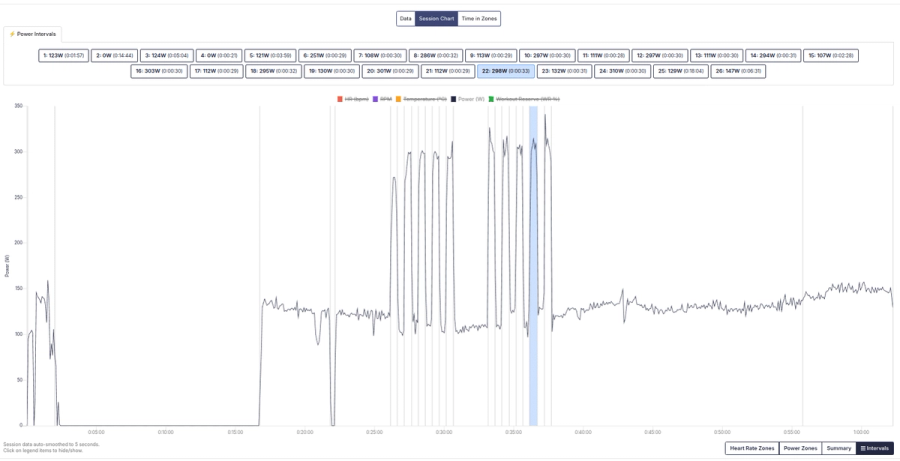
Figure 2. Structured 30/30 HIIT ride executed on the trainer. Efforts are automatically detected, whether they last 30 seconds, 33 seconds, or 27.
Figure 3. Structured ride executed outdoors (because who wants to ride the trainer on a summer day?). The target was 4 × 25-minute Zone 3 efforts, but execution wasn’t as clean as it should have been. I was compliant at the start and finish (circled in red), thanks to clear roads and steady pacing. But in the middle of the ride, things fell apart; urban sections, interruptions, and a 10-minute climb turned one of the planned 25-minute efforts into fragmented bursts (highlighted in yellow), well below the intended duration and consistency.

Figure 4. Race day (70.3 Nice): you can see the (completely unnecessary) aggressive way I attacked a short climb. The algorithm can identify the spikes in the noisier background. That helps us learn to improve the next time.
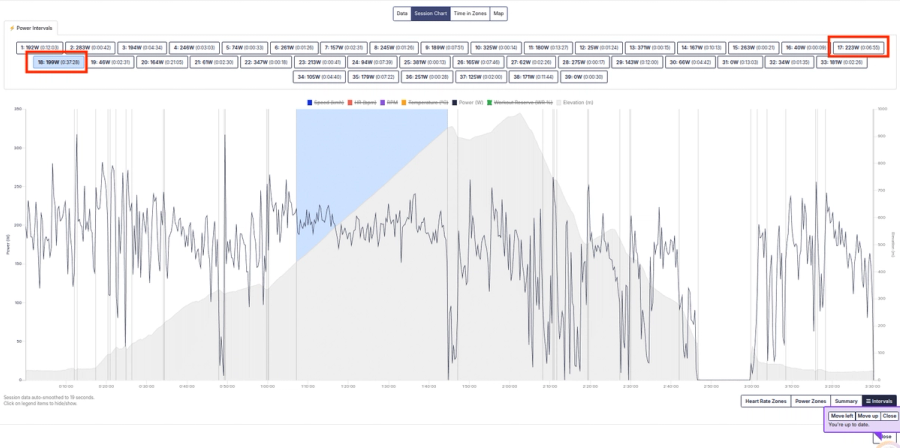
Figure 5. Race day climb: I managed to keep a somewhat steady effort along the climb. I started at around 220 W (almost Z4, because I got excited!) but slowly dropped to a steadier 200W fearing blowing up on the run.
Sport / MetricStatusETA*Cycling powerLive—Running power & paceAlphaQ4 2025Rowing powerPlannedEarly 2026Swimming pace (pool & OWS)Planned2026Heart-rate-only detectionR & D—Elevation (for climbing intervals)R & D—
*Dates subject to your feedback and the usual Athletica magic!
Start Free Trial
Visit our Coaching page to find out more about our coach platform.
Email hello@athletica.ai to book a personal demo and see how Interval IQ streamlines athlete management.
Is Interval IQ really automatic, or do I need to tag laps first?100 % automatic. Upload the file—Interval IQ clusters power data and creates “virtual laps” even if you never touched the lap button.
How accurate is the detection outdoors?On clean power-meter data, interval boundaries average ≤ 2 s error.
Do coaches see the same intervals?Yes—athlete and coach data sync in real time, so feedback threads stay fully aligned.
Can Interval IQ handle different sports and power sources? We are working on this, see the Roadmap.
How does Interval IQ distinguish between intentional intervals and incidental power fluctuations?The data is smoothened so incidental fluctuations are almost entirely removed. Although we keep separate intervals for exactly 0 power or corresponding to pauses.
Can I customize sensitivity or detection parameters?(E.g., minimum interval duration, power threshold, smoothing level)Not at the moment. But this is indeed currently considered as a possible UX improvement.
Does Interval IQ work well with noisy or less reliable power meters?Like for any type of data source, we work under the assumption that all data we receive is coming from an accurate device, so if there is garbage in, there is going to be garbage out.
Can I edit or override automatically detected intervals if needed?Not at the moment.
How does Interval IQ integrate with existing training plans or third-party platforms?At the moment, it works only within the Athletica platform – sign up to try it out!
Is Interval IQ available in real-time (live during rides) or only post-ride?Only post ride.
How does Interval IQ handle interval compliance scoring?This is work in progress – see our Roadmap.
Will Interval IQ work on workouts that include coasting, recovery spins, or mixed efforts?It works on any workout and ride.
Does the AI Coach use Interval IQ data to recommend recovery or rest days?This is work in progress – see our Roadmap.
Are detected intervals exportable for further analysis in other software?Not as of now.
Stefano Andriolo, PhD pivoted from theoretical physics (string theory, cosmology) to applied data science in endurance sport. Now he designs models to extract and analyze signal from athletic chaos. He’s chasing his own CP curve between code pushes, usually on Alpine climbs or prepping for his next 70.3.



