IRONMAN Kona Through the Eyes of an Athlete and a Coach
October 22, 2026
Paul Laursen
Luke Evans went 8:58 at Kona 2026 on 50 g of carbs an hour around a full-time job. His advice on qualifying and heat training and pacing.
Luke Evans finished Kona in 8:58, ninth in his age group. I had followed him throughout the day and exchanged messages with him and his family, but it was only when we sat down afterward that I heard the full story.
I had his Athletica race files open while we talked. We worked through the swim, the wind on the bike, and the point in the marathon where the heat became overwhelming. Then we turned to the questions athletes had sent us about qualifying for Kona and preparing for it around work and family.
What stood out was how often Luke returned to consistency. He had made deliberate decisions throughout the season to arrive in October still enjoying his training. On race day, he tried to bring the same patience to his pacing, even when the conditions made that difficult.
How did Luke’s Kona 2026 race go?
Luke’s swim went largely to plan. He started hard, found the feet of two very fast swimmers, and soon recognized that their pace was more than he wanted to sustain.
He let them go and eventually settled into another group. He came out in approximately 54 minutes, feeling ready for the rest of the day.
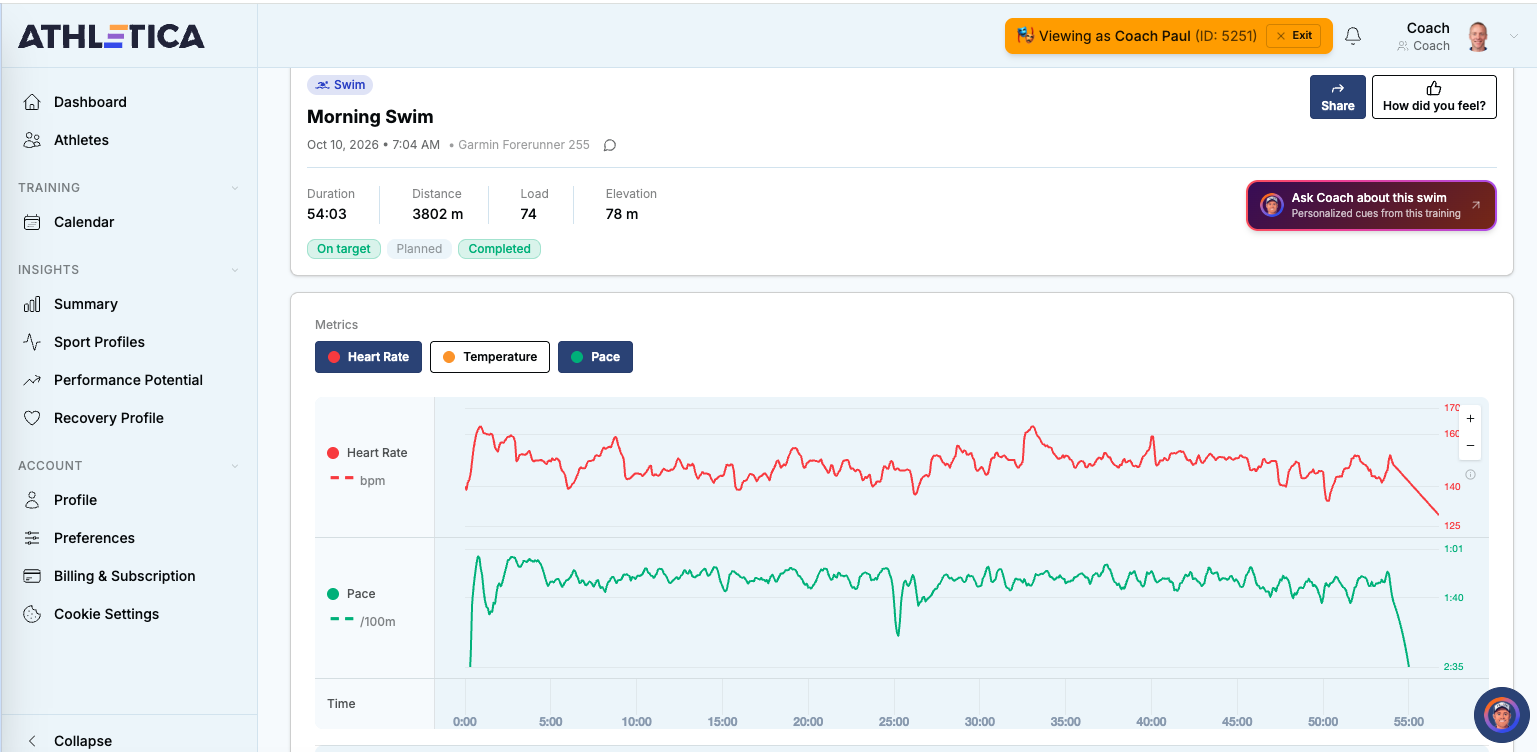
Looking at his file, I could see his heart rate sitting largely between 140 and 150 bpm. On its own that number says little, so some context. Athletica sets Luke’s zones from his threshold heart rate in each sport, not from a formula or a maximum he has never tested, and his swim threshold is 168 bpm. That puts 140 to 150 at about 85% of threshold, the bottom of his zone 3: a controlled effort for him, and consistent with coming out of the water feeling fresh. I asked whether an early rise corresponded to the moment he dropped off the faster swimmers. Luke thought that decision had happened earlier. Some later increases in effort, he explained, came from navigating through athletes who had started ahead.
That is why I like reviewing a file with the athlete. I can see the changes in effort, but Luke can explain what was happening around him.
Swim, 3.8 km in 54:03. Heart rate held between 140 and 150 bpm the whole way.
He spent extra time in transition putting on socks, calf sleeves, and a second pair of white calf sleeves over his forearms. He had tested the arm coverage during race week and found that soaking the fabric helped his arms feel cooler. Sun protection was another reason, encouraged by his mother.
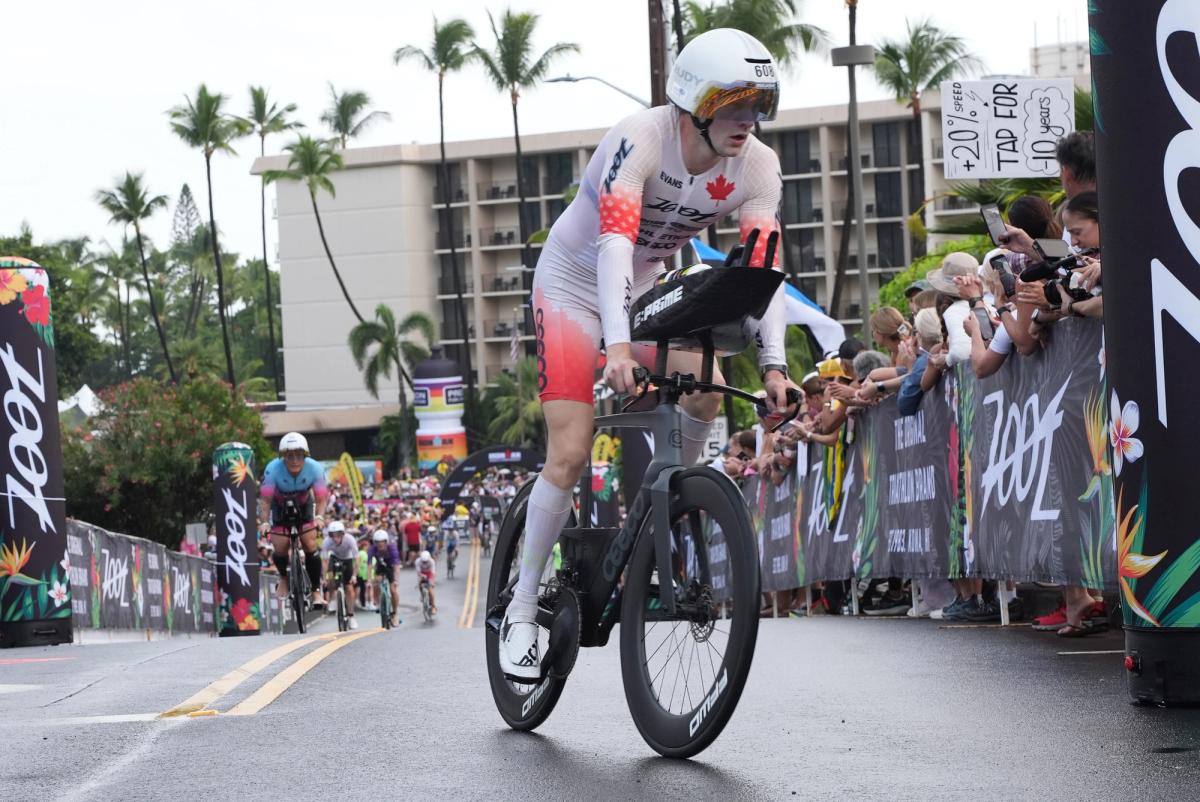
On the bike, he wanted to avoid repeating his 2024 race, when he had started at around 290 to 300 watts and felt he had cooked himself early.
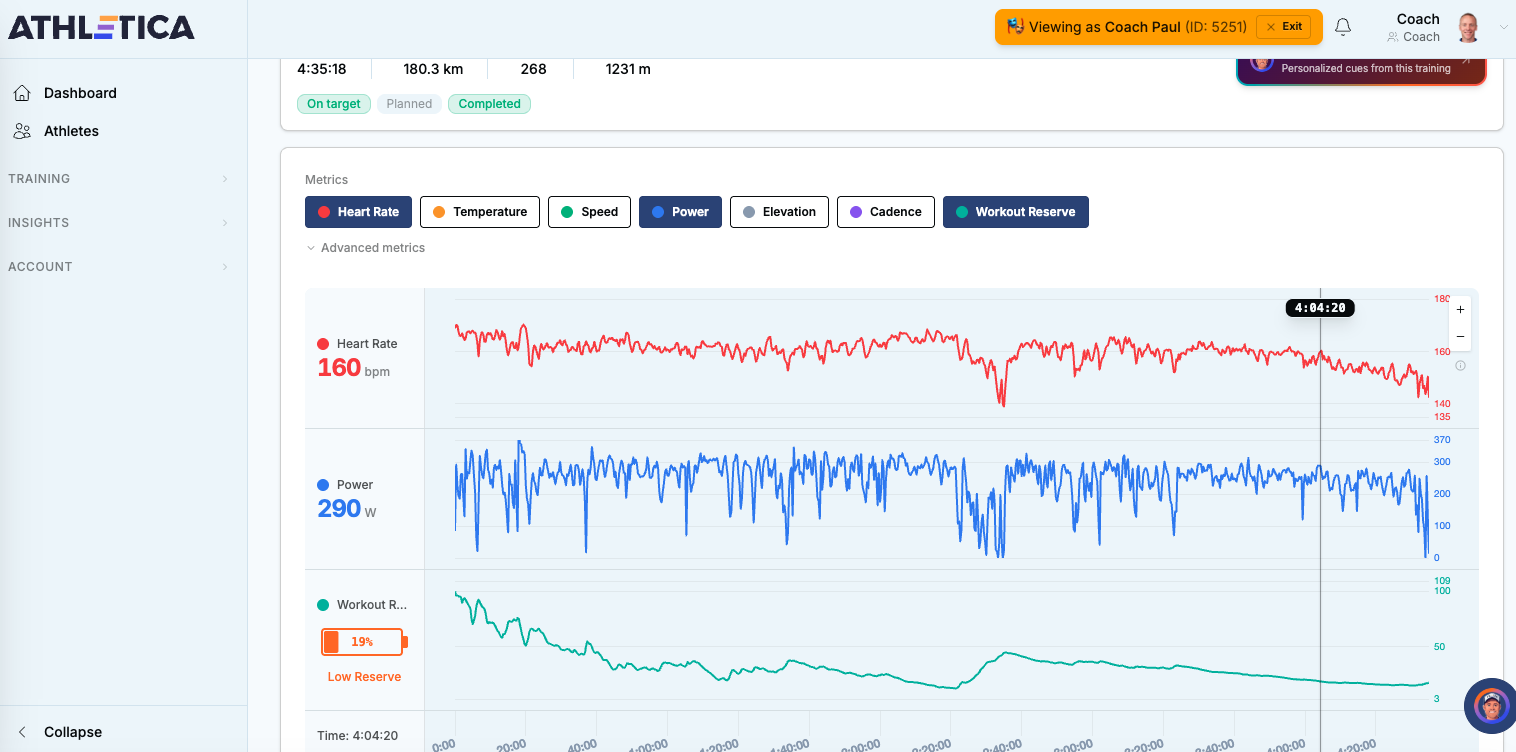
This time, his early average was closer to 230 to 240 watts. Over the full ride he averaged 248 W, with a normalized power of 263 W. His threshold power in Athletica is 344 W, about 4.5 W/kg, so the early average was 67 to 70% of threshold and the whole ride 72 to 76%, the upper half of his zone 2; the 290 to 300 W of 2024 was zone 3. His intention was to keep enough in reserve that he could have ridden another 10 to 15 watts harder if he needed to. What stands out in the file is that his heart rate did not follow the power. At upper zone 2 watts he would normally expect a heart rate near the top of his zone 2, around 145 bpm, and instead he averaged 160 for the ride, which is zone 3 and 91% of his cycling threshold heart rate of 175, with aerobic decoupling of nearly 7% between the first and second halves. That gap is the cost of the heat, and it was there long before the marathon.
The wind made that patience important. He had expected a tailwind coming home on the Queen K and instead found himself riding into a headwind, sometimes producing substantial power for much less speed than anticipated.
His response was to stop focusing on speed. Everyone was dealing with the conditions; he needed to manage his own effort.
He also slowed considerably at most aid stations to collect bottles. Having crashed at an aid station in a previous race, he wanted to stay upright and make sure he got what he needed.
Bike, 180 km in 4:35:31 at about 160 bpm. Workout Reserve reached 19% at 1 h 40 and sat near zero for the final 90 minutes.
The Workout Reserve trace adds another perspective. Our model estimated his reserve at 19% by one hour and 40 minutes, with the trace near zero for the final 90 minutes.
Luke had ridden conservatively by his own standards, but the model still suggested that much of his reserve was spent before the marathon began. In milder conditions, I would have considered him capable of a marathon around 2:55. In Kona, my reading is that the additional cost of the conditions reduced the margin he had available later at the Energy Lab.
For the first 27 to 28 km, Luke ran alongside Nicolas Rigaux of France. They communicated through gestures and a mixture of French and English, settling into a pace that suited them both.
Luke began around 4:15 per kilometer, ran much of that section closer to 4:20, and later moved toward 4:30. He was deliberately holding back, aiming to run 10 to 15 seconds per kilometer slower than he felt capable of at that moment.
Coming out of the Energy Lab, with the wind behind him, he began to feel much hotter. He deliberately slowed to five-minute kilometers and walked the aid station near the top.
Even that adjustment, he felt afterward, may not have been enough.
When Rigaux caught him around 30 to 31 km, Luke tried to stay alongside him for a couple of minutes before realizing he could not maintain the pace.
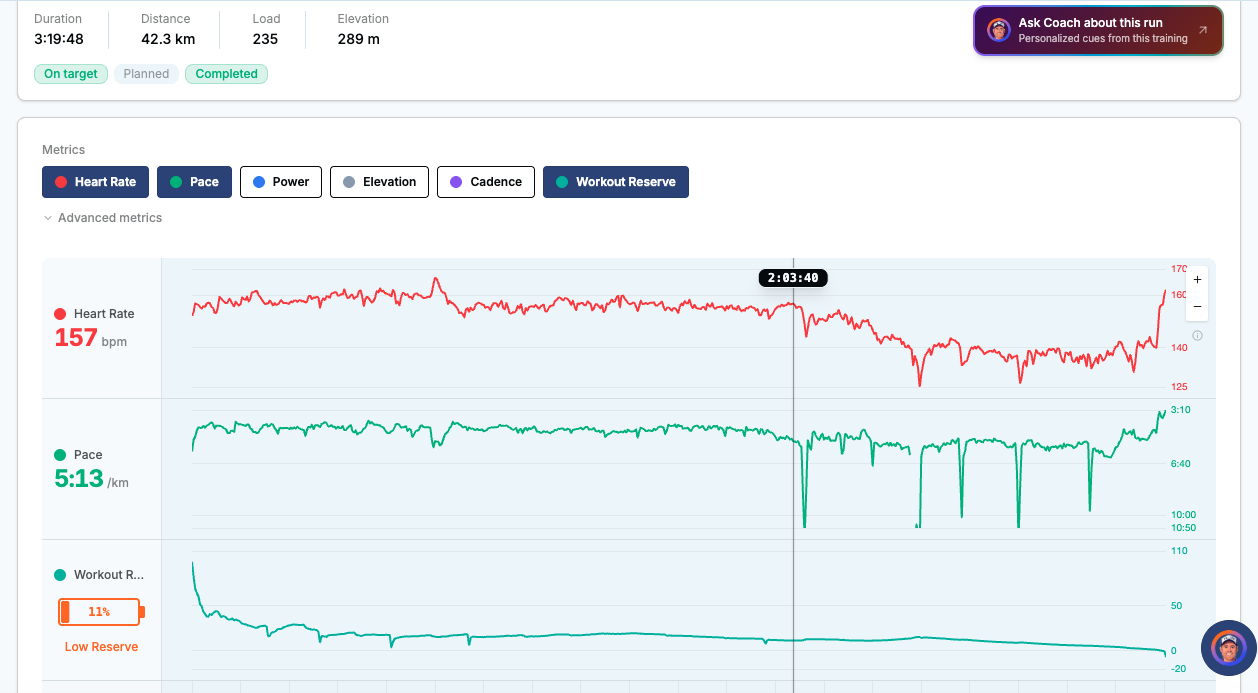
Run, 42.2 km in 3:20:58. Pace and heart rate fall together from 2:03, the Energy Lab. The spikes from 27 km are walked aid stations.
In the later part of the file, his pace and heart rate fall together, with heart rate moving from around 157 into the low 130s. For context, his threshold pace is 3:39 per kilometer and his running threshold heart rate is 173 bpm. A marathon at 4:15 to 4:30 sits in his zone 2 by pace, yet 157 bpm is 91% of threshold and the top of his zone 3 by heart rate. That is the same pattern as the bike, zone 2 output at a zone 3 heart rate, and it is what overheating looks like in a file. Once his heart rate dropped to the low 130s, zone 2 for him, he was running five-minute kilometers, zone 1 by pace. The repeated changes around aid stations correspond with his account of walking, collecting water and ice, and running again.
My interpretation was that heat was limiting his ability to continue producing the same effort, rather than a simple cardiovascular ceiling. That also matched Luke’s experience: he felt overheated and believed the heat, rather than a lack of fuel, was the main problem.
For an age-group athlete who wants to qualify for Kona, what would you tell them to focus on over the next year?
Luke’s answer was immediate: consistency.
He emphasized fitting in the easy aerobic training your life can accommodate and finding ways to enjoy it. The amount will differ between athletes, depending on their background, work, family, and other commitments.
He also made the point that aerobic activity does not always have to look like a formal triathlon session. Riding with family, walking, or cross-country skiing can be part of an active week alongside the structured training.
What concerned him was the athlete who commits to an extremely demanding 12-week block but cannot maintain the routine afterward.
That connected with something he had consciously managed throughout his own season. After feeling fed up with training at the end of the previous year, he wanted to reach Kona still motivated.
“If you push too hard in January, February, even March, you might be incredibly fit in April,” he said. “But then you’re not going to want to train in May and June.”
We had talked about this throughout the year. Kona was the goal in October, so he needed an approach he could continue for months.
There were adjustments along the way. He came to Revelstoke for a ski weekend with us. He traveled to Turkey with his wife’s family, left his bike at home, and ran when he could. Two outings in Cappadocia were among his favorite runs of the year.
Those experiences helped him keep enjoying the process. For me, that was an important part of the preparation.
How did you fit the training around work, family and the rest of your life?
“My entire schedule is built around my work, my day job,” Luke told me.
He is a professional engineer, and working from home a few days a week gives him some flexibility. The time saved on commuting can go toward training, eating, resting, or preparing for a session.
He often rides from around 6 a.m. until 8 or 8:30. During the cooldown, he may start organizing the working day by sending messages to colleagues and contractors.
Easy indoor riding also gives him room to entertain himself. Sometimes he plays a computer game; sometimes he answers emails. Hard sessions require his full attention.
I liked how practical he was about it. He did not claim to have perfect time management. He admitted that he still spends too much time online. But he has found arrangements that help the training fit around his responsibilities.
I had also noticed comments in Athletica about easy run-walks with his wife, Jen, who has been building toward running 5 km.
They go at her pace, which is considerably slower than his usual running pace. That does not bother him during those sessions. He gets some easy movement and they spend time together.
When I mentioned that they were also making time for their relationship, he said that was more important than anything he was doing in the sport.
And when I described his year as balanced, he laughed. His wife, he pointed out, might not necessarily agree. Twenty hours of training a week is still a substantial commitment.
That is worth keeping in the story. His preparation depended on flexibility and support, as well as the decisions he made about his time.
What’s your best tip for preparing for Kona’s heat and wind?
Luke began with an honest acknowledgment: given that he had overheated on the run, he was not going to pretend he had solved Kona.
“I can tell you what I did though,” he said.
For the wind, he acknowledged that he had done little specific preparation. Most of his riding was indoors, and his outdoor routes did not regularly expose him to comparable conditions.
He identified bike handling and becoming comfortable in the aerobars in windy conditions as the relevant skills. During race week, the wind had worried him, particularly when passing trucks interrupted it and made the bike feel less predictable.
On race day, having more of the road available helped. He still found parts of the course intimidating, but the steadier wind and additional space made them more manageable than he had feared.
For heat, he had completed indoor rides using extra clothing, gradually increasing the time he spent in those conditions.
I had seen his comments on those sessions throughout the preparation. He was making a deliberate effort to prepare for the move from Ontario to Kona.
The point Luke stressed was that the additional heat work could not compromise his other training.
His clothing choices, session durations, and heart-rate responses were specific to what he did. I would keep those details in the context of his preparation rather than present them as a session for every reader to reproduce.
The race also gave us something to review. Luke had prepared for the heat and tried to hold back throughout the day, yet still reached a point where he could not sustain his running.
His own reflection was that even five-minute kilometers out of the Energy Lab may have been too fast for how he was feeling. That is a useful observation to carry into future races in similar conditions.
How much should you eat during an Ironman?
Luke’s fueling approach came from trying to address gastrointestinal problems he had experienced in previous races.
When he won IRONMAN Canada in Ottawa, he consumed approximately 140 grams of carbohydrate per hour on the bike, largely from maple syrup. He had intended to continue a high intake on the run, but gastrointestinal distress affected his marathon.
He explained that large carbohydrate quantities had caused problems for him from different sources, especially while running.
At IRONMAN Arizona, we tested a lower intake: around 50 grams of carbohydrate per hour on the bike and 20 to 25 on the run. Luke avoided the gut problems and ran his best marathon, but he also bonked around seven hours into the race. That gave us something to work with. We had improved his tolerance, but still needed to refine the fueling to support him through the full distance.
In Kona, he calculated that he consumed approximately 225 grams of carbohydrate on the bike: six UCAN gels, four scoops of UCAN across his bottles, and one caffeinated Maurten gel.
That worked out to less than 50 grams per hour. He reported no energy problems or gastrointestinal issues on the bike and felt ready to run. He made one toilet stop during the marathon, which he did not attribute to his nutrition. Dan Plews, whose Kona age-group record still stands, raced it on the same 50 g an hour, and did the same when he went under eight hours in California.
For Luke, that was an improvement on his previous experience.
And just to be clear, I'm not telling anyone to race on 50 g an hour. If you tolerate 90 and perform on it, take 90. The lesson is that the number is yours to find, and the only way I know to find it is to test it in training, which is what Luke was doing on every long ride that preceded this one.
Which training sessions made the biggest difference for you?
Luke found this difficult to answer because he did not want to give one session too much credit.
“There’s no one training session that does the specific magic,” he said. “It’s the consistency over time.”
If he had to choose, he would identify the long rides and runs.
In 2025, he aimed to ride four hours every Saturday. In 2026, that became five hours, with some rides extending to six or six and a half. There were occasional adjustments when time was limited, but the habit remained remarkably consistent.
Those rides often covered approximately 135 to 200 km. By race season, the distance of an IRONMAN bike leg felt familiar.
Luke found that striking himself. He had come into the sport without a cycling or running background, and now he could describe 180 km as a distance he was comfortable riding.
I think that familiarity contributed to his confidence. He had repeatedly spent that time on the bike and knew what the distance felt like.
Luke also emphasized that his schedule was not the only way to accumulate the training. Other athletes might distribute their riding differently across the week.
His answer kept coming back to the same place: build the work over time, make it manageable, and keep doing it.
What does a consistent Ironman year look like in the data?
Overnight HRV, January to race week. The 7-day average sits inside the 60-day normal range for most of the year and above it from August.
The first chart shows Luke’s overnight HRV from January to race week, with the seven-day rolling average against his 60-day normal range.
For much of the year, the average sits within that range. It drops below it in late March, when training load was high, and sits above it from August onward.
My reading was that he had generally managed the training stress well and was showing a favorable response as the championship approached. I interpret that alongside his completed sessions and how he feels, rather than treating the chart as a complete account of adaptation.
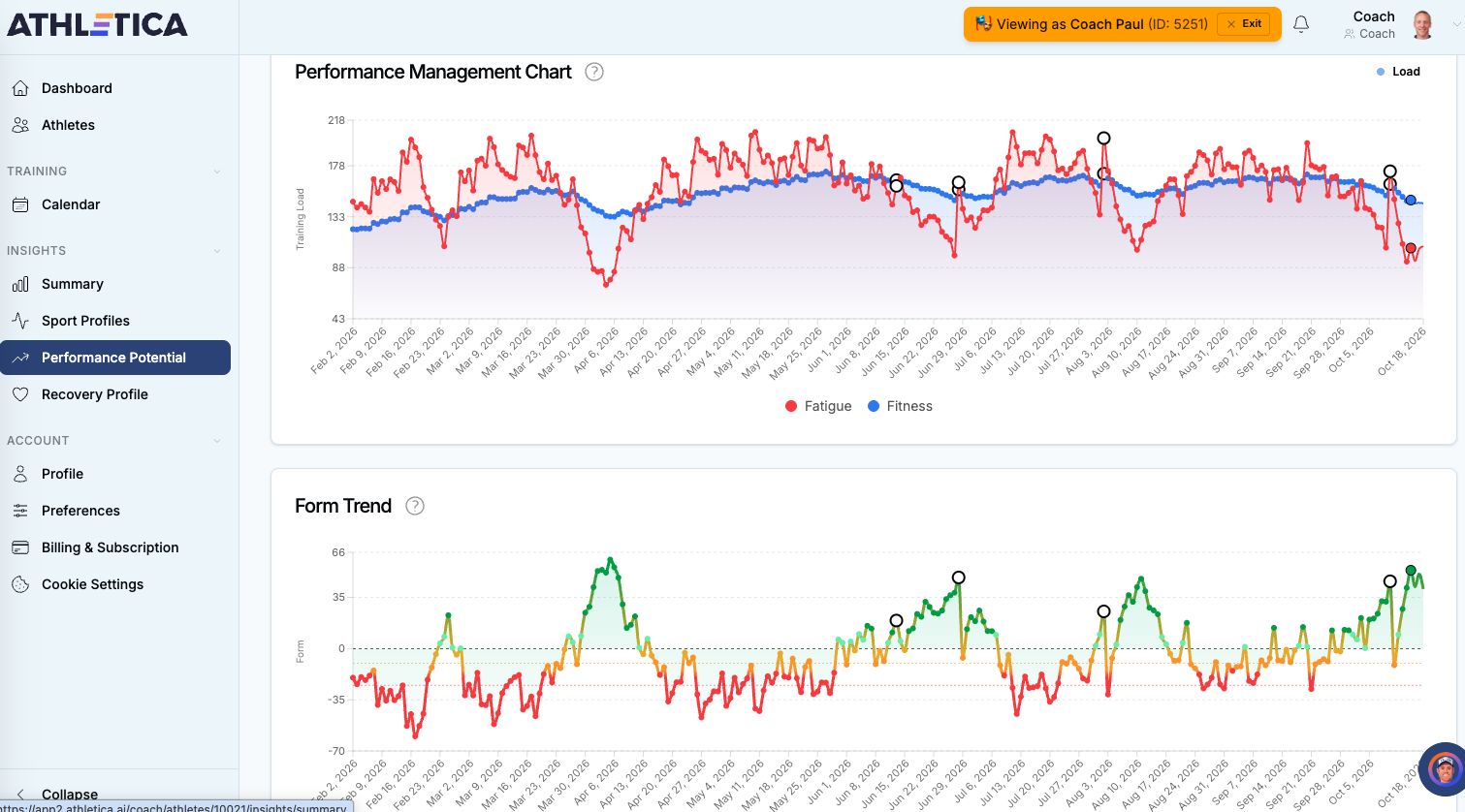
Fitness, fatigue and form, February to race day. Fitness peaks in late September; form is positive through race week.
The second chart shows fitness, fatigue, and form from our training-load model. Fitness builds toward a peak in late September, while modeled fatigue drops through the taper, leaving form well into positive territory for race week.
There is no large January spike followed by a hole in June. To me, it reflects an athlete who trained a lot while generally avoiding the pattern of pushing himself into the ground.
What I’d take from Luke’s year
As his coach, I keep returning to three parts of the preparation and execution: a long ride nearly every weekend for ten months, a fueling approach tested and refined across training and races, and a controlled bike effort that he maintained even while he believed he was leading his age group.
The biggest change I would examine is the pacing out of the Energy Lab. In my view, that section may have cost him the opportunity to contend for a podium. Luke also felt he needed to slow further there, despite already making a deliberate adjustment.
I did not come away thinking a lack of fitness was the central problem. I came away thinking about how to use the fitness he had under those conditions.
For now, he is taking a month without scheduled training. He planned a few weekends away without putting the bike in the car, something unusual for him.
Then he intends to build gradually again from mid-November toward Challenge Roth in July.
He has a clear target: to break eight hours, as Dan Plews did in California. Luke believes he is capable of it. From what I have seen in his training and race files, I think that ambition is within reach.
I am looking forward to being there for the next part.
Train consistently. Race smart at Kona.
Athletica's triathlon plans adapt to your life — balancing training load, recovery, and race-day readiness week by week, whether you're a full-time athlete or fitting it around work and family.
How do you qualify for Kona as an age-group athlete?
Luke’s advice is to build consistent training over months, combining easy aerobic volume that fits your life with the higher-intensity sessions in your plan. He progressed from 10:50 at his first IRONMAN on nine or ten hours a week to 8:19 at Arizona on around 20. His improvements accumulated over several years rather than one breakthrough block.
How much training does it take to qualify for Kona?
There is no weekly hour count that guarantees a slot. It depends on the athlete, age group, and circumstances. Luke averaged just under 19 hours a week in 2026, rising above 20 when healthy, after gradually building from nine or ten hours in 2021. His emphasis was on a workload he could maintain across the season, rather than a demanding 12-week block followed by months of lost motivation.
How do you train for Kona’s heat?
Luke used repeated indoor rides with extra clothing, including layered long johns, a hooded sweater, and a rain jacket. He built toward FTP over 10 minutes, then rode at his zone 2 power, gradually extending that section from around 30 to 35 minutes to approximately 70. His heart rate was around 150 to 160 bpm, which is 86 to 91% of his cycling threshold heart rate of 175, at power that would normally sit in his zone 2 heart-rate range, below 145 bpm. That drift is the point of the session. These were his individual session details. He emphasized keeping the additional heat work from compromising key training, and his race highlighted the continued importance of pacing despite preparation.
How many carbs per hour should you take during an Ironman?
The original discussion used approximately 50 to 90 g per hour as a practical range to individualize through testing, rather than a fixed target for everyone. Luke raced the Kona bike leg on just under 50 g per hour after higher intakes had caused gastrointestinal problems. Dan Plews’ approximately 50 g-per-hour intake provided another comparison in our conversation. The aim is to find an approach that supports your performance and that you can tolerate, including when running.
How should you pace the bike at Kona?
Luke aimed to feel as though he could sustain another 10 to 15 W above his current effort, rather than riding at the limit of what he believed he could hold. He rode the first hour around 230 to 240 W and averaged 248 W for the ride, 72% of his threshold, with heart rate close to 160 bpm across much of the bike, zone 3 for him at zone 2 power. Even so, his modeled Workout Reserve reached 19% by one hour and 40 minutes. His experience reinforces the need to account for the conditions and protect the marathon, rather than chase speed into the wind.