May 6, 2025
Paul Laursen
How to train in Zone 2: calculate your heart rate zone, choose your sessions and build your aerobic base with adaptive plans for runners and cyclists.

If you’re curious about the research foundations of Zone 2 training, this concept isn’t new—it’s been championed for decades by endurance expert and HIIT Science co-author Dr. Philip Maffetone. His work around Maximal Aerobic Function (MAF)—essentially what we now refer to as Zone 2—was explored in depth in a 2020 article published in Frontiers in Physiology. For those wanting an even deeper dive, a foundational study by Dr. Stephen Seiler and colleagues in 2007 examined how training intensity impacts recovery in elite athletes, highlighting the unique physiological stress response of working above Zone 2. You can read that paper here on PubMed.
Choose your activity:
🏃 Running
🚴 Cycling
🏊 Swimming
🚶 Brisk walking
🚣 Rowing
Frequency: 2–5 sessions per week
Duration: Start with 30–45 minutes, build to 60–90 minutes
Stay in zone: Use a heart rate monitor or the “talk test”
Athletica helps you automatically structure the right mix of Zone 2 and other intensities in your plan.
Searches for “zone 2 cardio” have exploded 300 % in the past 18 months and now outrank “HIIT workouts” on Google Trends – a reflection of the 2025 fitness landscape, where data‑driven endurance and longevity trump all‑out intensity. Mainstream outlets from the New York Post to ESPN are touting Zone 2 as the “fat‑burning secret the pros use.”
Yet Zone 2 is hardly new. Dr Phil Maffetone formalised it in the 1980s as Maximal Aerobic Function (MAF), while Prof Tim Noakes linked low‑intensity mileage to superior fat oxidation in the early ’90s (Noakes, 2003). Today Athletica stitches that heritage into an AI‑adaptive engine that calibrates your personal Zone 2—and adjusts it automatically as you improve.
🚫 Going too hard
If it feels like a workout, you’re probably out of Zone 2.
🚫 Impatience
Zone 2 benefits take time—but they’re long-lasting.
🚫 Skipping it entirely
If you only train hard, you’re missing out on critical aerobic development.
Don't build your Zone 2 base without guidance.
Trust Athletica to get it right.
AI-powered training that adapts to your fitness, your fatigue, and your life — every single week.
Try It Free for 14 DaysNo credit card required · Cancel anytime
Heart rate zones are defined ranges of exercise intensity based on a percentage of your maximum heart rate. They serve as a framework to tailor workouts, ensuring that training sessions are aligned with specific fitness goals.
By monitoring which zone you’re in, you can optimize your workouts for fat burning, endurance building, or performance enhancement. For instance, Zone 2 training, which involves exercising at 60–70% of your maximum heart rate, is particularly effective for improving aerobic capacity and promoting efficient fat metabolism. This structured approach allows athletes to train smarter, not just harder.
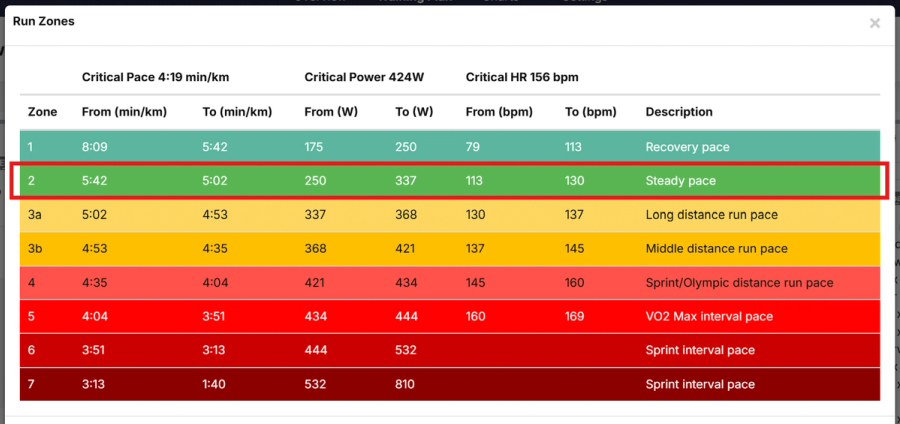
Zone 2 training is a low-to-moderate intensity workout zone where your body primarily uses fat for fuel, not carbs. It’s a powerful way to improve your aerobic base, burn fat efficiently, and build long-lasting endurance.
This is the training zone elite endurance athletes return to again and again to build their “engine.”
Zone 2 might feel slow, but physiologically it’s doing a lot:
🧠 Increases mitochondrial density
Your muscles get better at using oxygen and producing energy.
🔥 Improves fat metabolism
Your body learns to use fat for fuel more efficiently—saving glycogen for harder efforts.
❤️ Boosts cardiovascular health
Your heart becomes stronger, more efficient, and better at delivering oxygen.
⏱ Speeds recovery and reduces injury risk
Low stress, high reward. You recover faster and avoid overtraining.
Athletica uses a combination of real-world performance data and well-researched physiological markers to set your training zones. If you’re new and haven’t synced workouts or done a fitness test yet, a good starting estimate for your Zone 2 heart rate is based on the MAF method:
👉 180 − your age
Then adjust:
Your Zone 2 range is then about ±5 bpm around that number.
Zone 2 is where aerobic engines are built.
Let Athletica build yours.
Structured guidance backed by science — so every easy run, ride, or swim actually counts toward your goal.
Start Training Smarter — It's FreeNo credit card required · Cancel anytime



