Why You Feel Flat Three Weeks Before Your Ironman: Parasympathetic Overreaching, Explained
October 9, 2026
Paul Laursen
Feeling flat but not unfit three weeks before your Ironman? Parasympathetic overreaching explained: what it is, why the taper fixes it, how HRV shows it.
This week I sat in on our monthly call with a group of Athletica development athletes, and Luke Evans, who races Kona in a couple of weeks and who you may recognise from the Athletica home page, described something I have heard from nearly every Ironman athlete I've coached at that point in the build. Physically, he said, he felt pretty good, but mentally he was done, and the strange part was the shape of it: anything a touch below race pace felt easy and he could hold it for hours, yet ask for 15 seconds per kilometre faster and it hurt out of all proportion to the pace.
Then he gave me the detail that really made me smile. His easy runs and his race-pace runs sit about 50 seconds per kilometre apart, and his heart rate on the two is within three to five beats. To most athletes that sounds like a broken heart rate monitor or a broken athlete, and it is neither. What Luke is describing is parasympathetic overreaching, and in my experience it is about the most reliable sign I know that a big block has done what we asked of it. I suspect it is on a few minds at this time of year.
What is parasympathetic overreaching?
Parasympathetic overreaching is the state an endurance athlete lands in after weeks of heavy training, when the rest-and-repair branch of the nervous system is running so strongly that heart rate sits low at every pace, HRV drifts up, and high-intensity effort feels harder than it should. It is functional, meaning it reverses within about a week of reduced load, and in my view it is the normal end point of a well-built Ironman block rather than a sign that something has gone wrong.
What does parasympathetic overreaching feel like?
The ceiling comes down and the floor stays where it was. You can go all day at a moderate effort, a diesel engine as I put it to Luke, but the top gear won't engage no matter how much you want it to. Heart rate sits low at every pace and refuses to climb when you push, waking up is hard, and the intervals you do get through feel harder than the numbers say they should. Sleep is very welcome and there is never enough of it. Meanwhile the easy sessions feel suspiciously fine, which is exactly what convinces the athletes I coach that they have lost their fitness rather than banked it.
What is happening in the nervous system?
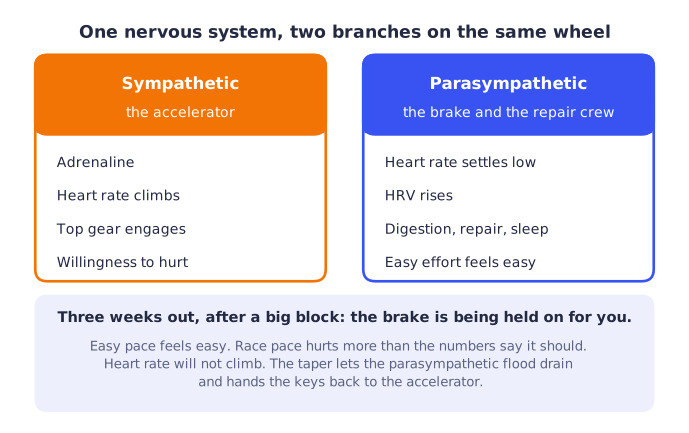
The way I explain it to athletes is that two branches of the autonomic nervous system share the wheel. The sympathetic branch is the accelerator, with its adrenaline, high heart rate and willingness to hurt, and the parasympathetic branch is the brake and the repair crew. After weeks of big volume the body floods the system with parasympathetic tone, and it doesn't let go just because there's a hard session on the calendar. Resting heart rate drops, heart rate variability (the beat-to-beat wobble in your heart rhythm, which grows when the brake is on) often rises, and the top of the heart rate range becomes really hard to reach because the brake is being held on for you.
Figure 1. Two branches, one wheel. After a big block the parasympathetic side holds the brake on, and the taper is what releases it.
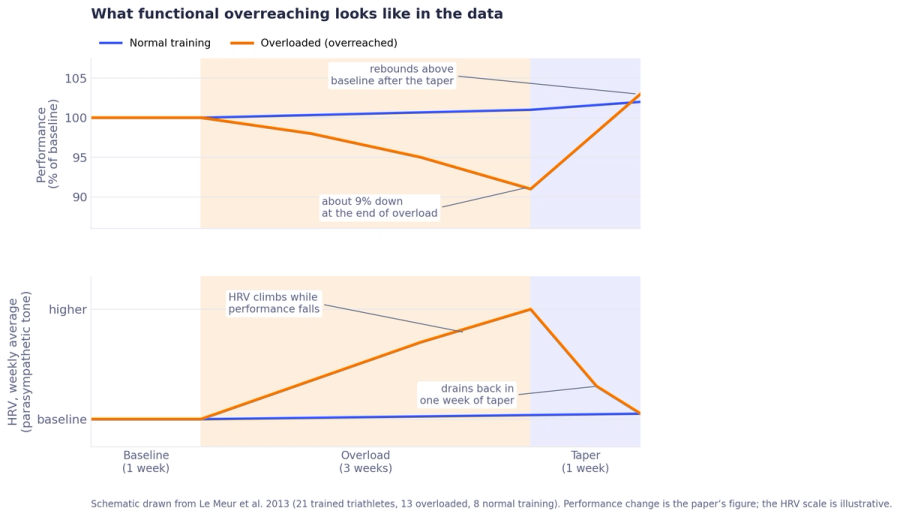
Yann Le Meur's group at INSEP showed this cleanly in triathletes, and I think it's the study to know if you want to understand the pattern. They took 21 trained triathletes, put 13 of them through a three-week overload followed by a one-week taper, and tracked HRV daily. Every one of the 13 lost performance during the overload, about 9% on average, while their weekly-averaged HRV went up, not down, and one week of taper reversed both. The same group, with my HIIT Science co-author Martin Buchheit on the paper, then ran 31 triathletes through a similar design, and the 10 who became overreached dropped about 2% in performance while their heart rate recovery after exercise sped up by around 8 beats per minute, so the tired athletes' hearts were recovering quicker than the fresh ones. Physiology is cool eh?
Figure 2. What the Le Meur study found, redrawn in plain terms. Orange is the overloaded group, blue is normal training. The HRV scale is illustrative; the performance numbers are the paper's.
There will be those who point out that HRV can fall in a fatigued athlete too. Granted. Dan Plews and I published a case comparison of two elite triathletes back in 2012, and the one who slid into overtraining showed HRV trending down for weeks before the poor performance showed up. But that is the far end of the road, the non-functional kind, and by then you could be looking at months to fix it. The parasympathetic flood I'm describing here is the functional version, and it appears to turn around within about a week once the load comes off. Same nervous system, different distance from the cliff.
How do HRV and heart rate show it?
Single readings won't catch it. Le Meur's team found that once-a-week HRV recordings missed the change because day-to-day noise swamped it, and only the weekly average showed the trend, so if you're tracking HRV I'd look at the seven-day rolling line rather than this morning's number. So put three things side by side: heart rate at a fixed easy pace (low and dropping), the HRV trend (flat or rising), and how hard the hard sessions feel (harder than the data). That triad, three weeks out, is the picture I look for.
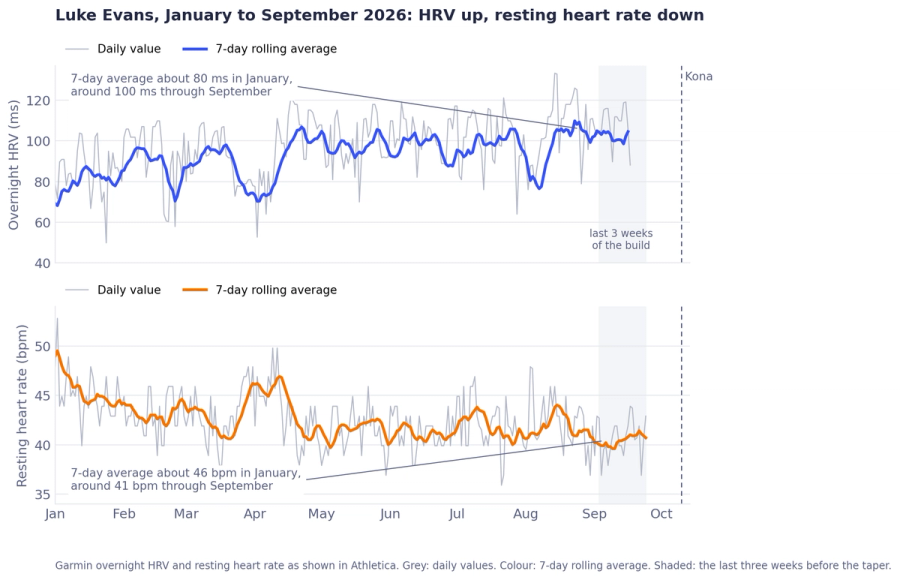
And Luke's own data show it. Below are his overnight HRV and resting heart rate from January to this week, pulled from his Athletica profile with his permission, with the seven-day average drawn over the daily values. HRV has climbed from a seven-day average near 80 ms in January to around 100 ms through September, and resting heart rate has come down from about 46 to around 41 beats per minute over the same stretch. There will be those who say a fitter athlete shows exactly those two trends, and I agree, because most of that nine-month drift is aerobic adaptation doing its job. What makes it the overreaching picture is the third piece: both markers are sitting at their season best in the very weeks he cannot get the top gear to engage. That is the Le Meur pattern, and it is the reason I told him not to worry.
Figure 3. Luke's season. Grey is the daily value, colour is the seven-day rolling average, and the shaded band is the last three weeks of the build before Kona.
We built Athletica's HRV-guided logic to read exactly that pattern and back the intensity off rather than pile more on, because the instinct at this point is to test yourself, and in my experience the test nearly always comes back with the wrong answer.
What is the taper for?
This, in my view, is the whole purpose of the taper. The volume comes off, the parasympathetic flood drains, and the sympathetic side gets the keys back, which in Le Meur's data took about a week. In Luke's case he has 16 days, and my advice to him was short: keep eating, keep trying to sleep, and stop trying to prove anything. The fitness from July and August is already in the bank, and nothing you do in the last two weeks adds to it, but plenty you could do would spend it.
What should you not do three weeks out?
Don't add intensity to check the engine still works, and don't panic when heart rate won't rise. But I wouldn't skip sessions wholesale either, and Luke's approach is the one I'd recommend. A prescribed 10 x 1 km became 8 x 1 km on a gravel track instead of the road, and a long session built around kilometre repeats and race pace became a 2 hour 15 minute run, all easy, because he wasn't up for pushing that day. The load stays roughly where the plan wanted it and the edge comes off, and something beats nothing. The plan, AI or otherwise, gives you the rails, and the athlete supplies the context.
For me, as someone who has coached a lot of athletes through the last three weeks before an Ironman, the flat feeling is a signal to trust rather than a problem to fix, because the nervous system is telling you the work is done. And just to be clear, I am not saying every flat patch is this. If you're ten weeks out rather than three, if heart rate is high at easy pace rather than low, or if you're sick, that is likely a different conversation with a different fix. Context wins.
So if you're three weeks out and the top gear won't engage, you haven't lost anything. You've trained, and now the taper can do its job.
Questions I get asked about this
Is parasympathetic overreaching the same as overtraining?
No. What I'm describing is functional overreaching, where performance dips for days to a couple of weeks and rebounds with rest, often to a higher level than before. Overtraining syndrome is the non-functional end, where performance stays down for months and the fix is not a taper. The feeling can be similar early on, and it's the time course that separates them.
Should I skip my last hard sessions?
Not wholesale, and I wouldn't recommend it. I'd take the edge off instead: fewer reps, a softer surface, or convert an interval session into a longer easy run so the load stays roughly similar. The block's work is done, and the last sessions are about keeping the pattern rather than adding fitness.
Does a low heart rate in training before a race mean I'm unfit?
Usually the opposite, in my experience. Low heart rate at a given pace, a stable or rising HRV trend, and a top end that feels harder than it should is the parasympathetic pattern that follows a big block. Unfit looks different, with heart rate high at easy pace and the easy sessions feeling hard as well.
How long does it take to clear?
In the triathlete overload studies I described above, about one week of taper reversed the HRV and performance changes. For an Ironman taper of two to three weeks, most athletes I've worked with feel the top gear return somewhere in the second week, and sleep and food seem to shorten that while extra intensity lengthens it.
Can HRV tell me on its own?
Not from one reading. I'd use the seven-day average and read it alongside heart rate at a fixed easy pace and how hard your hard sessions feel. Athletica's HRV-guided training reads that trend for you and adjusts the plan.
References
- Le Meur Y, Pichon A, Schaal K, Schmitt L, Louis J, Gueneron J, Vidal PP, Hausswirth C. Evidence of parasympathetic hyperactivity in functionally overreached athletes. Med Sci Sports Exerc. 2013;45(11):2061-71. https://doi.org/10.1249/MSS.0b013e3182980125
- Aubry A, Hausswirth C, Louis J, Coutts AJ, Buchheit M, Le Meur Y. The development of functional overreaching is associated with a faster heart rate recovery in endurance athletes. PLoS One. 2015;10(10):e0139754. https://doi.org/10.1371/journal.pone.0139754
- Plews DJ, Laursen PB, Kilding AE, Buchheit M. Heart rate variability in elite triathletes, is variation in variability the key to effective training? A case comparison. Eur J Appl Physiol. 2012;112(11):3729-41. https://doi.org/10.1007/s00421-012-2354-4
- Bellenger CR, Thomson RL, Davison K, Robertson EY, Buckley JD. The impact of functional overreaching on post-exercise parasympathetic reactivation in runners. Front Physiol. 2021;11:614765. https://doi.org/10.3389/fphys.2020.614765